🌍 Chapter 4: Where These Solutions Are Needed
Chapter 3 showed what regulators expect; this chapter shows where those expectations play out in the real world.
The same core principles—mapping, monitoring, calibration, and data integrity—apply very differently in a tall ambient warehouse versus a blast freezer, a reefer truck, or a hot-aisle data hall. If you treat all environments the same, you will either overspend, under-control, or both.
This chapter gives you an environment-by-environment view so you can:
- Prioritise where to start.
- Set realistic expectations for mapping and monitoring scope.
- Understand why certain spaces are inherently more fragile than others.
4.1 Environment-Based Segmentation
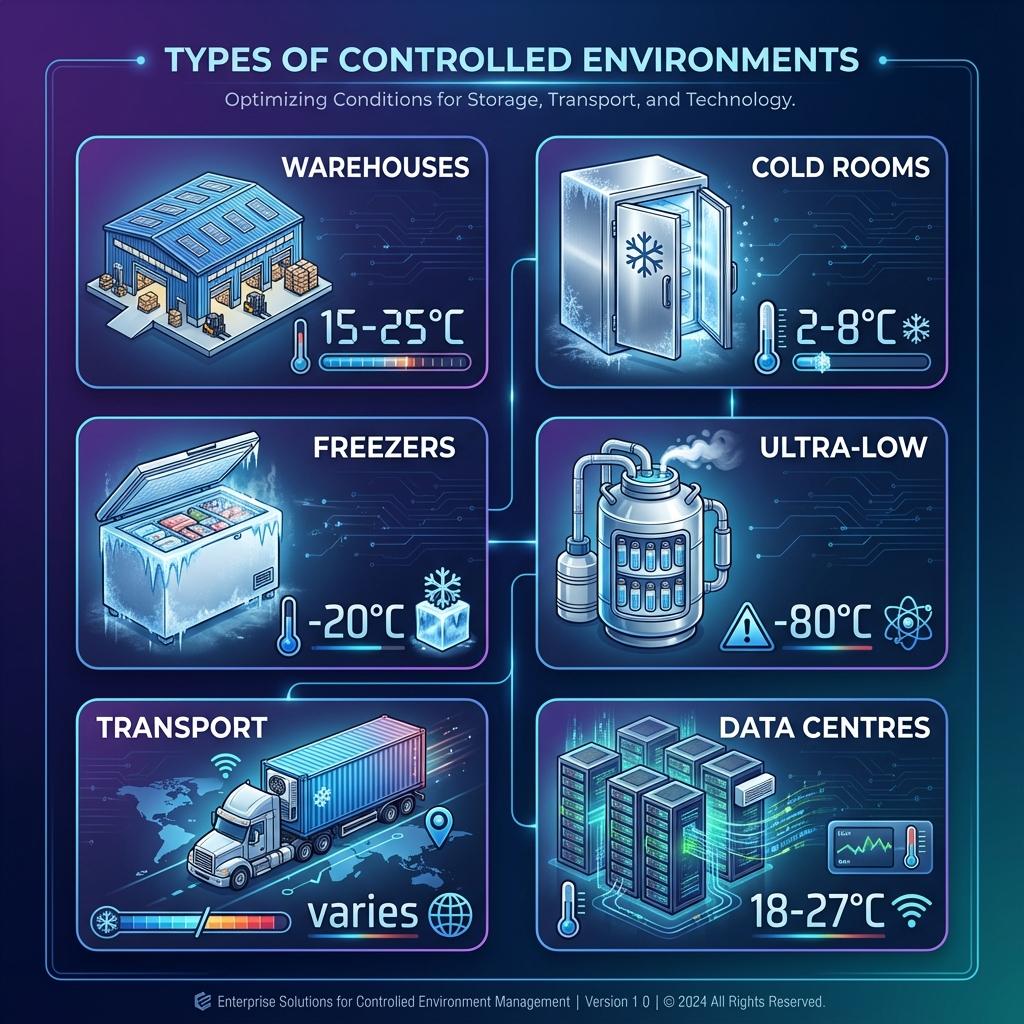
At a high level, temperature-sensitive operations fall into seven practical environment types. Nearly every pharma, food, logistics, or data-centre operation is a combination of these.
4.1.0 Snapshot Table – Environments at a Glance
| Environment Type | Typical Use | Key Challenges |
|---|---|---|
| Warehouses & distribution hubs | Bulk storage for pharma, APIs, food, packaging | Large volumes, high racks, stratification, mixed products, seasonal extremes |
| Cold rooms & walk-in freezers | Short- to medium-term storage at chilled or frozen temps | Door openings, defrost cycles, icing, high traffic near doors |
| Stability chambers & incubators | Controlled studies and lab environments | Tight tolerances, long durations, regulatory scrutiny |
| Production & packaging zones | In-process control, critical steps on lines | Local heat sources, moving air, open product exposure |
| Transport vehicles, reefers, passive containers | In-transit control for pharma and food | Vibration, air leaks, loading/unloading, variable ambient conditions |
| Retail cold chain nodes | Supermarket cabinets, back-of-house cold rooms, QSR storage | Customer access, door openings, open fronts, frequent product handling |
| Data centres, edge computing, server farms | IT white spaces, edge rooms, control rooms | Dense heat loads, hot/cold aisles, airflow patterns, redundancy requirements |
We’ll now look at each in more detail.
4.1.1 Warehouses & Distribution Hubs
Typical role
- Bulk storage and consolidation for finished pharmaceuticals, APIs, packaging materials, frozen and chilled foods, and intermediates.
- Often the central node in a national or regional supply chain.
Characteristics
- Large volume, typically high-bay racking.
- Mixed storage: different products, different packaging, sometimes different temperature classes within the same building.
- Influenced by external climate, roof exposure, and loading bay design.
Why mapping matters here
- WHO and USP guidance emphasise mapping of warehouses and large storage areas, specifically to identify hot and cold spots in high racks and corners.
- Stratification (warm air pooling at the top, cold at the bottom) can easily push upper-rack temperatures outside spec while floor-level probes look fine.
Typical mapping focus
- Vertical profiles (bottom/middle/top of high racks).
- Corners, near doors/loading bays, under roof lights or near external walls.
- Empty, partially loaded, and fully loaded conditions, ideally including seasonal extremes.
Monitoring strategy
- Fixed probes at worst-case and representative rack positions, based on mapping data.
- Extra points near loading bays or known weak spots, plus ambient references.
- Integration with WMS / quality release processes where product release depends on storage history.
4.1.2 Cold Rooms & Walk-In Freezers
Typical role
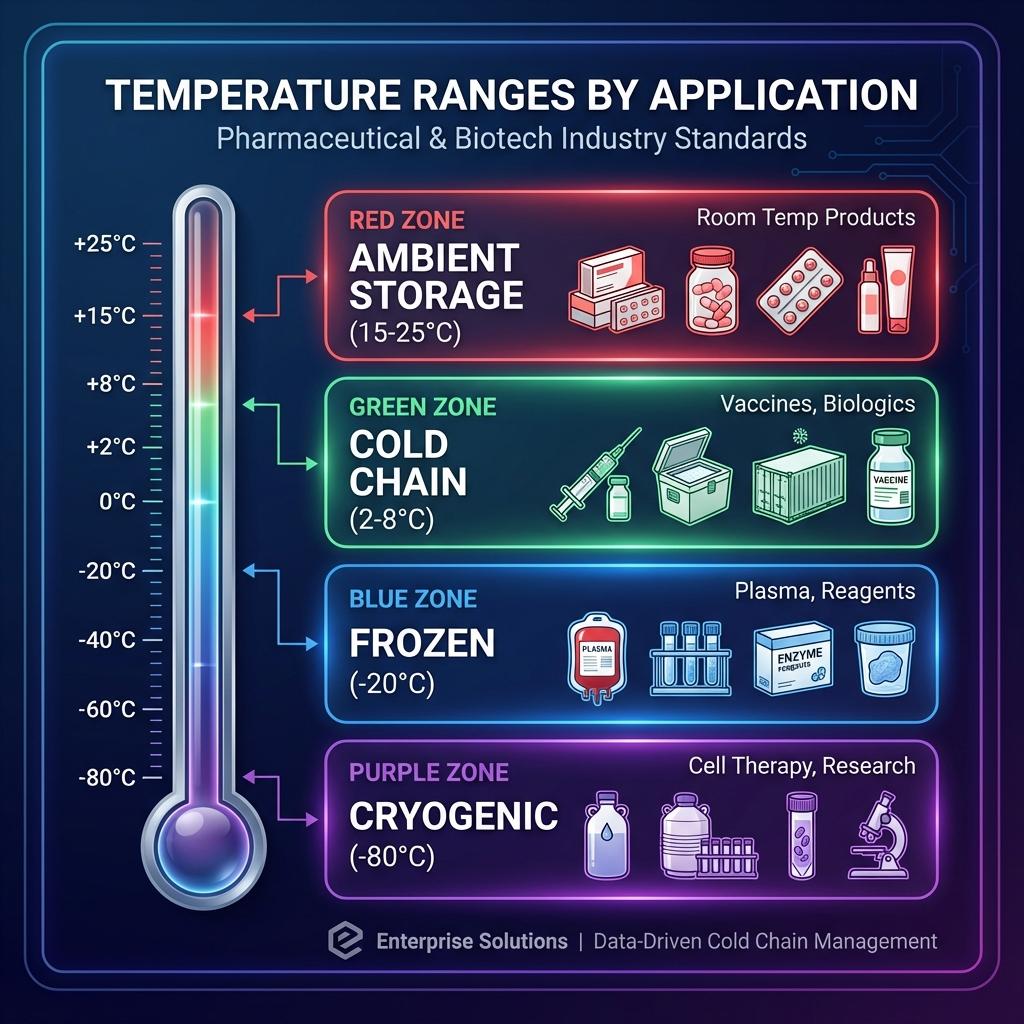
- Chilled (+2 to +8 °C) rooms for vaccines, biologics, dairy, meat, ready meals.
- Freezer rooms (−18 °C and below) for ice cream, frozen foods, frozen APIs, and intermediates.
Characteristics
- Relatively small volume but high traffic: doors opening frequently, people moving in/out.
- Evaporators and fans create significant airflow patterns; defrost cycles introduce periodic warming.
Why mapping matters here
- WHO technical supplements give dedicated guidance for mapping cold rooms and freezers to confirm that the entire usable volume remains in range and to locate hot/cold spots.
- Cold rooms and freezers are often where auditors spot issues first, because they are easy to access and high-risk.
Typical mapping focus
- Grid of loggers across the volume (corners, centre, near doors, near evaporators).
- Effect of door opening patterns and defrost cycles.
- Recovery times after simulated disturbances (door open, power loss test).
Monitoring strategy
- Probes at the warmest validated locations, not just wherever it’s convenient to mount them.
- Local digital displays for staff + central logging system.
- Alarm logic tuned so defrost cycles don’t trigger nuisance alarms, but real excursions do.
4.1.3 Stability Chambers & Incubators
Typical role
- Regulatory stability studies for pharmaceuticals (ICH conditions).
- Controlled incubators for microbiology, R&D, QA labs.
Characteristics
- Tight setpoints (e.g., 25 °C/60 % RH, 30 °C/65 % RH, 40 °C/75 % RH) with narrow allowable variations.
- Often fully loaded with product or samples; opening doors can disrupt conditions.
Why mapping matters here
- ICH stability guidelines and related concept papers expect chambers used for stability to be qualified, which in practice includes mapping under loaded and unloaded states.
- Small gradients can still matter because tolerances are tight and studies run for months or years.
Typical mapping focus
- Multiple levels/shelves, corners vs centre, near doors.
- Empty vs typical load conditions.
- Long enough duration to capture cycling and worst-case behaviour.
Monitoring strategy
- Dedicated monitoring probes at representative and worst-case points as identified by mapping.
- Integration with the stability management system; alarms that tie directly into QA workflows.
4.1.4 Production & Packaging Zones
Typical role
- Areas where products are manufactured, filled, packed, or labelled under defined temperature conditions (e.g., controlled room temperature, cool manufacturing areas).
Characteristics
- Multiple heat sources: equipment, people, lighting.
- Airflow from HVAC, local extract, open doors to adjacent zones.
- Different micro-environments within the same nominal temperature zone.
Why mapping matters here
- Mapping (often at controlled room temperature) demonstrates whether critical processing points actually experience conditions within specified ranges, not just the air in the HVAC supply duct.
- This is critical where process performance or product quality is temperature-sensitive (e.g., coating, filling viscosity, microbiological risk).
Typical mapping focus
- Operator height and equipment height at key processing steps.
- Areas near doors to higher/lower temperature zones.
- Vertical gradients in high-ceiling facilities.
Monitoring strategy
- Fewer monitoring points than in storage, but targeted: at representative workstations and critical steps.
- Trend analysis used more for process capability and comfort/safety than release decisions.
4.1.5 Transport Vehicles, Reefers & Passive Containers
Typical role
- Line-haul and local distribution of refrigerated and frozen foods.
- Pharmaceutical and vaccine distribution (road, sea, air, last-mile).
Characteristics
- Highly dynamic: loading/unloading, variable ambient temperature, changing routes.
- Mixing of products with different temperature sensitivities if not carefully segregated.
Why mapping matters here
- WHO technical supplements and refrigerated transport best-practice guides recommend qualification and mapping of vehicles and containers, often including nine-point profiles (front/middle/rear × top/middle/bottom) to identify hot and cold zones.
- Mapping helps determine safe loading patterns and set realistic expectations for pre-cooling and recovery times.
Typical mapping focus
- Fully loaded trailers with typical pallets and packaging.
- Pre-cool, stationary tests, and in-motion tests.
- Door-open simulations at docks and delivery points.
Monitoring strategy
- For food: may still rely on post-trip loggers or integrated reefer recorders, but best practice is moving towards real-time visibility for higher-risk loads.
- For pharma and high-value biologics: strong trend toward real-time in-transit monitoring and lane qualification, even where not yet legally mandated.
4.1.6 Retail Cold Chain Nodes
Typical role
- Supermarket open and closed display cabinets.
- Back-of-house walk-in chillers and freezers.
- Quick-service restaurant (QSR) and convenience outlet cold storage and display.
Characteristics
- Frequent door openings, customer interaction, and product handling.
- Open-fronted display cases with strong interaction between ambient store conditions and cabinet air.
Why mapping matters here
- Independent studies show that open refrigerated display cases often exhibit significant temperature variation and may fail to maintain recommended temperatures for fresh-cut produce and other chilled items.
- Mapping and profiling help retailers identify problem shelves or positions and adjust loading, setpoints, or airflow.
Typical mapping focus
- Vertical profiles at front/back, top/middle/bottom of cabinets.
- Impact of night blinds, store ambient conditions, and door-open frequency.
Monitoring strategy
- Fixed probes connected to a store-wide monitoring system, plus local checks with handheld thermometers.
- Alarm limits linked to HACCP plans; corrective actions may include product checks, segregation, or discard.
4.1.7 Data Centres, Edge Computing & Server Farms
Typical role
- Enterprise and co-location data centres.
- On-prem server rooms in factories, banks, hospitals, logistics control towers.
- Edge nodes in warehouses, telecom sites, and remote facilities.
Characteristics
- High power density and concentrated heat loads.
- Hot/cold aisle configurations and complex airflow patterns.
- Very low tolerance for sustained excursions—downtime is expensive.
Why mapping matters here
- ASHRAE and related best-practice documents stress careful temperature sensor placement and hot/cold aisle management; empirical measurements are used to confirm that rack inlets stay within recommended classes and that CFD models are realistic.
- Thermal mapping campaigns (even if not called that) are used to locate hot racks, dead spots, or recirculation zones that can cause local overheating.
Typical mapping focus
- Rack-level mapping at top/middle/bottom in the cold aisle.
- Cross-aisle gradients and containment effectiveness.
- Response of the environment to simulated failures (CRAC outage, fan failure).
Monitoring strategy
- Distributed temperature and sometimes differential pressure sensors across racks and aisles.
- Integration into DCIM / BMS platforms with alarms, trend analytics, and capacity planning tools.
4.2 Risk Vectors by Environment
Now that we’ve segmented the environments, we can look at the recurring ways they fail. The same risk vectors—hot/cold spots, stratification, door openings, power failures, load variability, airflow disruption—show up differently in each context.
4.2.1 Core Risk Vectors Defined
-
Hot/cold spots
Localised regions that consistently run warmer or cooler than the average. Mapping studies for warehouses, cold rooms, and chambers specifically seek to identify these as part of WHO and USP guidance.
-
Stratification
Vertical temperature layering (warm at top, cool at bottom) in high spaces or tall cabinets, driven by buoyancy and airflow patterns. This is well documented in mapped warehouses, cold rooms, and retail display cases.
-
Door openings & infiltration
Warm or humid air entering controlled spaces during door opens—especially in cold rooms, loading docks, and retail cabinets.
-
Power failure & equipment downtime
Loss of refrigeration, HVAC, or fans, with subsequent warm-up. WHO annexes explicitly propose using mapping and qualification data to plan for power failures and emergency responses.
-
Load variability
Changes in fill level, pallet configuration, or product mix that alter airflow and thermal capacity. Common in warehouses, reefers, and retail.
-
Airflow disruption
Blocked vents, poorly placed baffles, misaligned louvers, or bad rack/cabinet layout that lead to stagnant zones or recirculation (especially in data centres and high-bay storage).
4.2.2 Risk Vectors by Environment – Matrix View
| Environment Type | Dominant Risk Vectors | Practical Implications |
|---|---|---|
| Warehouses & distribution hubs | Hot/cold spots, stratification, load variability, power failure | Top-rack products at risk while floor probes show in-spec; seasonal swings; partial loads behaving differently than full loads. |
| Cold rooms & walk-in freezers | Door openings, hot/cold spots, defrost cycles, power failure | Short excursions during loading; slow recovery after power loss; ice accumulation affecting airflow. |
| Stability chambers & incubators | Minor hot/cold spots, airflow disruption, component failure | Small gradients still critical for long-term studies; fan failures or blocked vents can create quiet but serious deviations. |
| Production & packaging zones | Stratification, local heat sources, door openings | Critical process steps may see different temps than wall sensors; transient excursions affecting product quality or microbiology. |
| Transport vehicles & reefers | Load variability, airflow disruption (blocked air channels), door openings, equipment failure, ambient extremes | Pallets near doors or bulkheads at higher risk; receiving disputes when loggers and reefer setpoints disagree. |
| Passive containers & shippers | Load pattern, pre-conditioning, ambient extremes | Incorrect pre-conditioning and packing leading to early phase-change material exhaustion and centre-of-pack excursions. |
| Retail cold chain nodes | Open fronts, door openings, stratification, ambient influence, poor night-blind use | Product at front/top of cabinets runs warm; frequent customer access drives spikes; night blinds not used consistently. |
| Data centres & server farms | Airflow disruption, hot/cold aisle imbalance, load variability, local hot spots, power & cooling failures | Specific racks or servers overheat; PUE increases; localised trips or outages despite average room temps being “acceptable”. |
4.2.3 How Mapping Helps You Tame Each Risk
Hot/cold spots & stratification
- Mapping studies explicitly aim to identify these patterns and quantify their impact. WHO and industry concept papers recommend using mapping data to define monitoring probe locations and acceptance criteria, especially in large stores and chambers.
- In data centres, ASHRAE-aligned guidelines recommend mapping rack inlets at top/middle/bottom and across aisles to verify that all inlets remain within the thermal envelope.
Door openings
- Mapping under defined door-opening patterns (e.g., scheduled door cycles) shows how far and how long temperatures deviate, and how quickly they recover once the door closes. WHO supplements and refrigerated transport guides emphasise this for cold rooms and reefers.
- This evidence supports SOPs: maximum door-open times, use of air curtains, staging practices, and labour planning.
Power failures and equipment downtime
- Qualification guidance (e.g., WHO TRS 961 Supplement 7) suggests using mapping and qualification data to understand warm-up curves during power loss, helping you design backup power and product rescue plans.
- For data centres, equivalent “loss-of-cooling” drills and transient mapping help model how quickly temperatures rise when CRAC units or pumps fail.
Load variability
- Mapping at different loading patterns (e.g., 30 %, 70 %, 100 % full) reveals how airflow changes and where dead zones appear; best-practice transport and warehouse guides explicitly address loading and airflow patterns as critical to temperature performance.
Airflow disruption
- In warehouses and cold rooms, mapping may reveal stagnant zones behind stacks, near walls, or under mezzanines—driving changes in pallet layouts or baffle designs.
- In data centres, thermal mapping combined with airflow best practices (front-to-back cooling, hot/cold aisle layouts) is used to redesign rack layouts, blanking plates, and containment solutions.
4.2.4 Translating Risk Vectors into Practical Requirements
From a buyer’s perspective, the risk vectors in this chapter should feed directly into your URS and evaluation criteria later in the guide:
- If your primary risk vector is door openings (e.g., high-traffic vaccine stores, retail cabinets), you need:
- Mapping that includes realistic door-open patterns.
- Monitoring with fast sampling and time-delay alarm logic that distinguishes transient spikes from real risk.
- If your primary risk is stratification and hot racks (e.g., warehouses, data centres), you need:
- Mapping at multiple heights and depths.
- Sufficient sensor density at validated worst-case positions, not just one probe at head height.
- If power failure is the big fear (e.g., markets with unstable grids, critical regional hubs), you need:
- Mapping/qualification data that includes power-off tests and warm-up curves.
- Monitoring systems with robust buffering, battery-backed loggers, and clear emergency SOPs.
- If you operate flexible, multi-product warehouses or fleets, you need:
- Mapping and monitoring that are repeatable and scalable as layouts and lanes change.
- Configurable platforms where new zones, vehicles, and nodes can be added without losing visibility.
How to Use This Chapter
- Quality & Validation – Use these environment and risk profiles to decide where mapping must be comprehensive and frequent, and where a lighter approach is justified.
- Operations & Engineering – Use the risk vectors to challenge your layouts, door policies, loading patterns, and maintenance practices.
- IT / Data Centre Ops – See your white spaces, edge rooms, and control rooms as simply another class of temperature-critical environment that needs mapping and monitoring discipline—not separate worlds.
In Chapter 5, we’ll build on this environment view to define the solution stack—the hardware, software, services, and documentation layers that actually control these risks in practice.
Environment Types Overview
This flowchart shows the different controlled environment types: