📐 Chapter 3: Regulatory & Compliance Landscape Across Domains
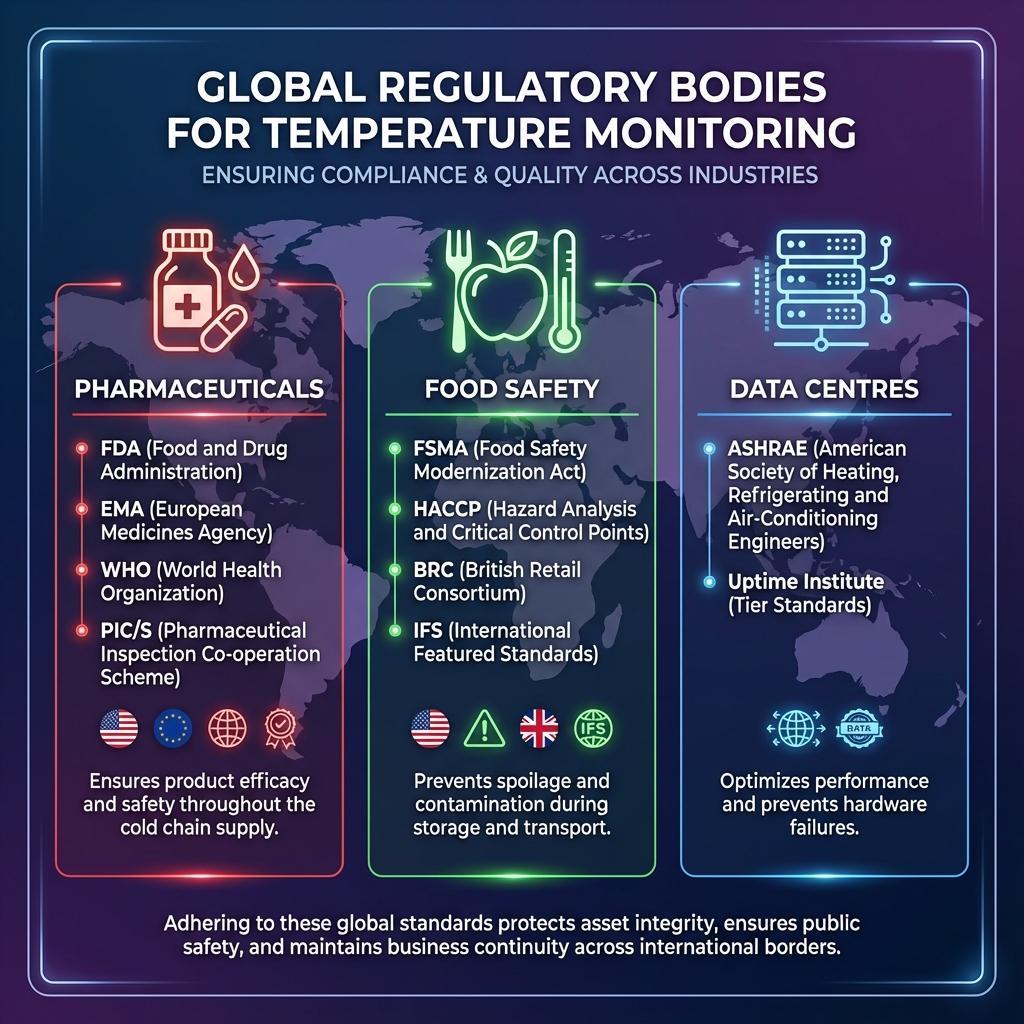
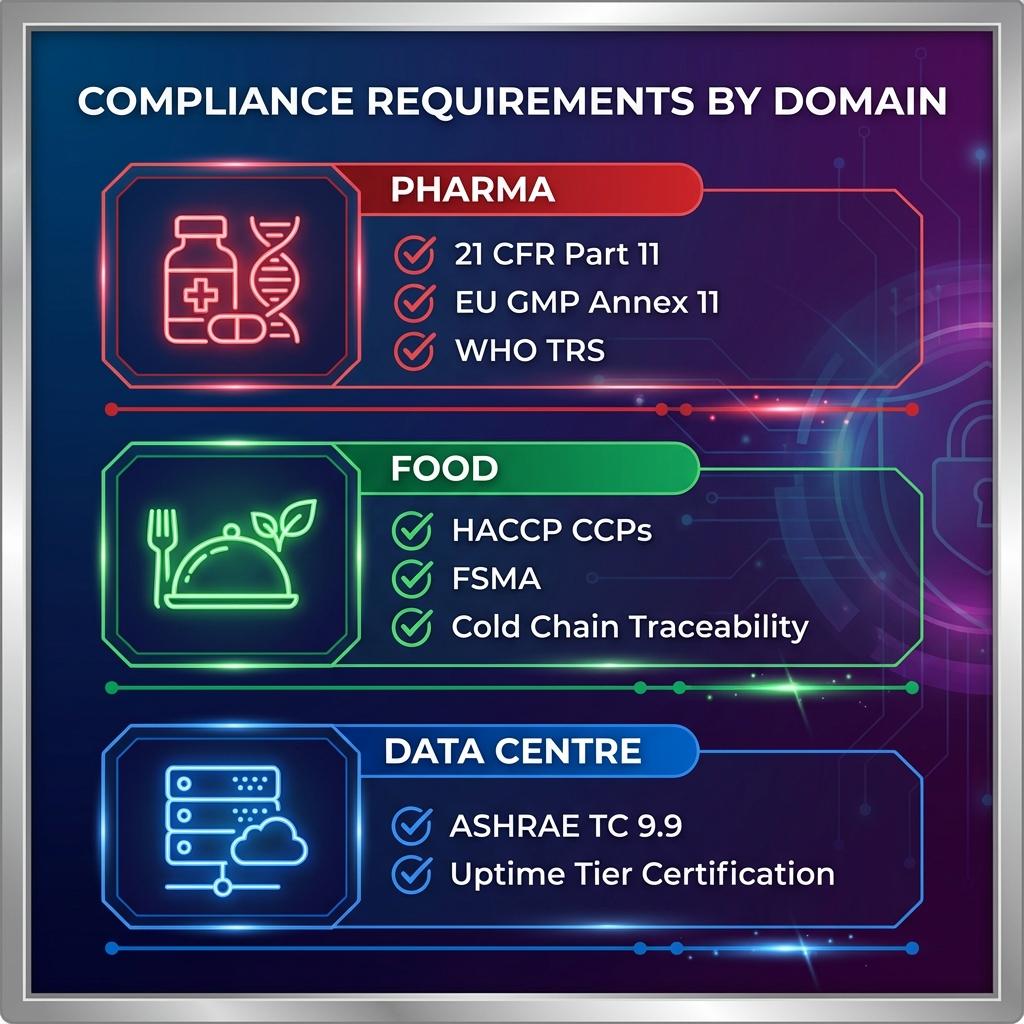
This chapter connects the technical language of temperature control to the real language of regulators, auditors, and standard-setters. The goal is simple: if you are responsible for quality, compliance, or risk in any temperature-critical environment, you should be able to read this chapter and know exactly what “good” looks like on paper—and what will get you into trouble.
Wherever possible, key guidance documents are publicly downloadable; these are noted so your team can pull the originals into your own QMS or validation library.
3.1 Pharmaceutical, Biotech & Life Sciences
In pharma and biotech, temperature mapping and monitoring are not “nice quality extras”. They are tied directly to product quality, patient safety, and GxP compliance.
3.1.1 Core WHO & GDP References
-
WHO TRS 961, Annex 9 – Model guidance for TTSPPs
- Defines principles for storage and transport of time- and temperature-sensitive pharmaceutical products (TTSPPs), including requirements for equipment qualification, mapping, monitoring, and calibration of transport devices.
- Emphasises that temperature-controlled facilities and vehicles must be qualified and that temperature control and monitoring devices must be calibrated and verified at defined intervals.
Download: WHO TRS 961 Annex 9 – Model guidance for storage & transport of TTSPPs (WHO site).
-
WHO TRS 961, Annex 9 – Supplement 8: Temperature mapping of storage areas
- Provides step-by-step instructions on how to design and execute temperature mapping studies for cold rooms, freezers, and other storage areas, including sensor placement, test duration, and documentation requirements.
- States that all mapping exercises must be fully documented to demonstrate compliance to management, clients, and regulators.
Download: WHO TRS 961 Annex 9, Supplement 8 – Temperature mapping of storage areas.
-
WHO TRS 992, Annex 5 – Technical Supplements
- Adds detailed supplements for qualification of temperature-controlled storage areas, refrigerated road vehicles, temperature-controlled transport operations, maintenance, and checking accuracy of monitoring devices.
Download: WHO TRS 992 Annex 5 – Technical supplements to model guidance for storage & transport of TTSPPs.
-
EU GDP Guidelines for Medicinal Products (2013/C 343/01)
- Require that storage conditions are monitored and recorded, and that temperature-controlled equipment is qualified and regularly maintained.
- Explicitly reference risk-based control of temperatures, including seasonal variations and transport risks.
Download: EU Guidelines on Good Distribution Practice of medicinal products for human use.
3.1.2 Computerised Systems – EU Annex 11 & 21 CFR Part 11
-
EU GMP Annex 11 – Computerised Systems (read together with EU GDP and main GMP text)
- Requires that computerised systems impacting product quality and patient safety are:
- Validated for intended use.
- Equipped with audit trails for GMP-relevant data.
- Designed with appropriate access control, backup, and data retention.
- Requires that computerised systems impacting product quality and patient safety are:
-
21 CFR Part 11 – Electronic Records and Electronic Signatures
- Applies to electronic records and signatures used to satisfy FDA record-keeping requirements.
- Requires controls including:
- Unique user IDs and secure passwords.
- Computer-generated audit trails that record who did what and when.
- Linkage of signatures to records so they cannot be excised or reused.
Download: eCFR – 21 CFR Part 11; FDA guidance “Part 11 – Scope and Application”.
3.1.3 MHRA, EMA, ICH – Expectations Around Mapping & Monitoring
- MHRA GxP Data Integrity Guidance
- Defines data integrity as ensuring data are complete, consistent and accurate across their lifecycle, and explicitly endorses ALCOA/ALCOA+ principles.
- Requires robust data governance, including roles, responsibilities, and oversight for computerised systems used in GMP/GDP environments.
- EMA / ICH
- ICH Q1A(R2) and related stability guidelines require storage conditions to be controlled and documented, aligning stability studies with labelled storage conditions; this implies validated chambers, mapping, and calibrated monitoring.
- EMA GDP & GMP guidance documents align closely with WHO and EU GDP, expecting qualified storage and transport, documented mapping, and compliant monitoring systems.
3.1.4 What Regulators Expect in Practice
For pharma, biotech and life sciences, regulators expect you to demonstrate a coherent chain of control:
| Area | Regulatory Expectation (Simplified) | Key References |
|---|---|---|
| Temperature Mapping | Perform mapping for new or modified storage areas and periodically thereafter; use a documented protocol, analyse results, define hot/cold spots, and file a formal report. | WHO TRS 961 Annex 9; TRS 961 Supplement 8; TRS 992 Annex 5 (Supp. 7). |
| Continuous Monitoring | Use calibrated devices with sufficient accuracy; monitor continuously; have alarms, responses, and documented investigations for excursions. | WHO TRS 961 Annex 9; WHO Technical Supplement on monitoring systems. |
| Calibration | Establish a calibration programme with traceability to national/international standards, appropriate intervals, and documented certificates. | WHO TRS 961 Annex 9 section 6.7; WHO Technical Supplements on checking accuracy. |
| Computerised System Validation | Validate monitoring and mapping systems, manage change control, maintain audit trails, and ensure role-based access and secure backups. | EU Annex 11; 21 CFR Part 11; GAMP 5. |
| Documentation | Maintain mapping protocols, raw data, reports, monitoring records, alarm logs, deviation investigations, CAPAs, and validation documentation. | WHO TRS, EU GDP, FDA/EMA data integrity guidance. |
For Quality & Compliance leaders, the takeaway is blunt: if it isn’t mapped, monitored, calibrated, and validated—and if the data aren’t trustworthy—regulators will treat your controls as missing.
3.2 Frozen & Chilled Food Environments
Food safety regulations are built around hazard analysis and preventive controls. Temperature abuse is one of the most common and most unforgiving hazards.
3.2.1 Codex HACCP & General Principles of Food Hygiene
-
Codex General Principles of Food Hygiene (CXC 1–1969)
- Establish the global baseline for Good Hygiene Practices (GHPs) and HACCP.
- Time–temperature control is explicitly highlighted as a key aspect of hygiene control; inadequate temperature control is identified as a major cause of foodborne illness and spoilage.
Download: Codex General Principles of Food Hygiene (with HACCP Annex).
-
HACCP Implementation
- Temperature-critical steps (chilling, freezing, storage, transport, display) are typically classified as Critical Control Points (CCPs).
- This creates a regulatory expectation for:
- Defined critical limits (e.g., ≤ −18 °C for frozen, ≤ 5 °C or 7 °C for chilled depending on jurisdiction).
- Monitoring procedures (what, how often, by whom).
- Verification and records (calibration of devices, review of logs).
3.2.2 FSMA – Sanitary Transportation & Traceability
In the US, the Food Safety Modernization Act (FSMA) put preventive controls and supply chain oversight front and centre.
-
FSMA Final Rule on Sanitary Transportation of Human and Animal Food
- Requires shippers of temperature-controlled food to implement written procedures to ensure refrigerated vehicles and equipment are adequately pre-cooled and that temperature is maintained during transport.
- Requires records of procedures and actions related to temperature control.
Download: FSMA Sanitary Transportation Final Rule summary & full text (FDA).
-
FSMA Traceability & Preventive Controls (e.g., FSMA 204)
- Increase emphasis on end-to-end visibility of where temperature-controlled foods have been and under what conditions, pushing the industry towards systematic monitoring and data retention.
3.2.3 EU Food Hygiene – Regulation (EC) No. 852/2004
-
Requires food business operators to ensure food safety through hygiene rules and HACCP principles, including temperature control requirements based on scientific risk assessment.
-
Recognises that food safety must be ensured throughout the food chain, from primary production to retail, which makes temperature mapping and monitoring relevant at storage, processing, and distribution stages.
Download: Regulation (EC) No. 852/2004 on the hygiene of foodstuffs.
3.2.4 Retail-Level Refrigeration Expectations
- National authorities (e.g., EU Member States, FDA Food Code in the US) commonly specify maximum display temperatures for chilled and frozen foods, and expect routine temperature checks and log records to verify control.
- Many retail HACCP guides require periodic verification that display cabinets and storage rooms are capable of holding product within limits under worst-case loading and ambient conditions—this is essentially temperature mapping by another name.
For food businesses, the story is clear: mapping validates your cold rooms and display units; monitoring and documented checks prove you’re in control day-to-day.
3.3 Cold Chain Logistics (Pharma + Food)
Cold chain logistics sit at the intersection of product quality, transport risk, and multi-party responsibility. Regulators and standard-setters now expect that risk to be systematically engineered and documented—not hand-waved away with “we used a reefer truck”.
3.3.1 WHO Model Guidance & Technical Supplements
The WHO suite around TRS 961 creates a complete playbook for storage and transport:
- TRS 961 Annex 9 – Model guidance for storage & transport of TTSPPs, including:
- Qualification of temperature-controlled road vehicles.
- Calibration and verification of transport temperature monitoring devices.
- TRS 992 Annex 5 Technical Supplements, including:
- Supplement 7 – Qualification of temperature-controlled storage areas (IQ/OQ/PQ).
- Supplement 8 – Temperature mapping of storage areas.
- Supplement 11 – Qualification of refrigerated road vehicles.
- Supplement 12 – Temperature-controlled transport operations by road and air.
Together these documents expect that:
- Vehicles, containers, and storage locations are qualified under realistic operating conditions.
- Field shipment tests are used to demonstrate temperature distribution during actual or simulated transport.
- Monitoring devices used during transport are calibrated, verified, and periodically checked for accuracy.
3.3.2 IATA PCR & TCR – Air Cargo & Healthcare Shipments
For air transport and global logistics:
- IATA Perishable Cargo Regulations (PCR)
- Provide detailed instructions for shipping perishables, including quality management system expectations, temperature control procedures, and documentation.
- IATA Temperature Control Regulations (TCR)
- Define requirements and standards for temperature-sensitive healthcare products, including use of Time & Temperature Sensitive labels and acceptance checklists.
These are not “just airline rules” anymore; many regulators and pharma QA departments treat compliance with IATA PCR/TCR as baseline good practice for air freight cold chain.
3.3.3 GAMP 5 in Logistics
Although GAMP 5 is not logistics-specific, it has become the de facto reference for validation of GxP-relevant computerised systems, including:
- Warehouse Management Systems (WMS).
- Temperature Monitoring Platforms used in transport and distribution.
- Integration layers feeding data into QMS, ERP, and release systems.
GAMP 5 (2nd edition) emphasises:
- A risk-based lifecycle model for computerised system validation.
- Applying critical thinking to focus validation effort where it truly affects patient safety and product quality.
In practice, that means a cloud platform used to sign off on cold chain releases for biologics is not a casual IT tool—it must be validated and governed as a GxP system.
3.3.4 Real-time Monitoring in Transit – Must or Nice-to-Have?
Today’s reality:
- WHO and many regulators still accept post-trip loggers as long as risks are well managed and documented.
- However, industry guidance and major shippers increasingly see real-time or near-real-time monitoring as a risk-based expectation, particularly for:
- High-value / high-risk biologics and vaccines.
- Long, multi-stop international lanes.
- Routes with known infrastructure or handling risks.
For a Buyer’s Guide that needs to stay relevant through 2026, it is reasonable to frame real-time monitoring as:
- “Expected for high-risk lanes and products”, and
- “A strong differentiator” when demonstrating supply chain control to regulators and customers—even where not yet explicitly mandated in law.
3.4 Data Centres & Server Farms
In data centres, the regulatory flavour is different: it’s less about patient safety and more about uptime, asset protection, and contractual SLAs. But the underlying logic—define an envelope, validate it, monitor it—remains remarkably similar.
3.4.1 ASHRAE TC 9.9 – Thermal Guidelines
ASHRAE TC 9.9 has become the global reference point for thermal conditions in data processing environments:
- Earlier recommendations suggested an air temperature envelope of 20–25 °C (68–77 °F) at IT equipment inlets.
- Later editions broadened the recommended range to approximately 18–27 °C, with allowable classes extending beyond that depending on equipment class (A1–A4).
- Humidity envelopes and rate-of-change limits (e.g., RH 20–80 %, < 5 % RH change per hour) are defined to manage condensation and static risk.
Download: Selected ASHRAE TC 9.9 white papers and reference cards summarising the thermal guidelines.
3.4.2 Hot/Cold Aisle Containment & Thermal Envelope Compliance
While ASHRAE gives the envelope, operators must demonstrate that real environments actually comply:
- Best practice is to combine:
- Design tools – Computational Fluid Dynamics (CFD) to model airflow and hot spots.
- Empirical mapping – temporary deployment of temperature and sometimes airflow sensors across racks, aisles, and elevations to confirm CFD models and containment effectiveness.
This is essentially temperature mapping for IT spaces:
- Identify worst-case racks and locations (top of racks, aisle ends, near CRAC units).
- Map over time under high load and different external conditions.
- Use results to optimise sensor placement, threshold settings, and containment design.
3.4.3 Integration with DCIM, BMS & Monitoring Platforms
Data centre standards and best practice frameworks (ASHRAE, Uptime Institute, TIA) converge on the expectation that operators will:
- Use centralised monitoring systems—DCIM/BMS—to monitor temperature and environmental conditions across white spaces and supporting infrastructure.
- Implement redundant monitoring and alarms, with escalation to on-call staff.
- Use trend analysis to detect gradual drifts (blocked airflow, failing CRAC units) before they become acute incidents.
For buyers of monitoring solutions, the implication is clear:
- You need systems that can ingest data from rack-level and room-level sensors,
- Integrate with DCIM/BMS, and
- Support both incident response (real-time alerts) and continuous optimisation (trend and capacity analysis).
3.5 Data Integrity & GxP Software Expectations
Whether in pharma cold rooms or a multi-site monitoring platform, your data is only as valuable as it is trustworthy. Regulators have made data integrity a non-negotiable theme.
3.5.1 ALCOA & ALCOA+ Principles
Originally articulated by FDA and expanded by MHRA, ALCOA and ALCOA+ describe the qualities of trustworthy GxP data:
- Attributable – Who performed the action and when.
- Legible – Readable and permanent.
- Contemporaneous – Recorded at the time of the activity.
- Original – First capture or a verified true copy.
- Accurate – Correct, truthful, and with appropriate rounding/precision.
ALCOA+ extends this to:
- Complete, Consistent, Enduring, Available.
MHRA’s GxP Data Integrity Guidance explicitly references these principles and expects firms to embed them in their data governance and system design.
3.5.2 FDA & EMA Data Integrity Guidance
-
FDA – Data Integrity and Compliance with CGMP: Questions and Answers (2018)
- Clarifies that CGMP requires data to be reliable and accurate and demands controls such as:
- Unique user IDs (no shared logins).
- Restricted privileges for system administrators, ideally independent from routine users.
- Controls to prevent deletion or overwriting of CGMP data.
Download: FDA Data Integrity & CGMP Guidance (December 2018).
- Clarifies that CGMP requires data to be reliable and accurate and demands controls such as:
-
EMA / MHRA
- EMA reflection papers and MHRA guidance stress data governance, lifecycle management, and appropriate use of electronic systems, often citing ALCOA+ explicitly.
3.5.3 Electronic Signatures, Audit Trails & Role-Based Access
If your mapping and monitoring system is GxP-impacting (and for pharma, it usually is), regulators expect:
- Audit trails that are:
- Computer-generated,
- Secure and independent of record creators, and
- Capture creation, modification, deletion, and access of GxP-relevant data.
- Electronic signatures that:
- Are unique to individuals.
- Are linked to their records so they cannot be removed or reused in a misleading way (21 CFR 11.70).
- Role-based access control so that:
- Users can only perform actions consistent with their responsibilities.
- System admin rights are separated from those responsible for record content wherever feasible.
3.5.4 GAMP 5 – Risk-Based Validation for Monitoring Platforms
GAMP 5 (2nd edition) frames validation of monitoring platforms and related systems as a risk-based lifecycle exercise:
- Classify the system (infrastructure vs configurable package vs custom).
- Define which functions are GxP-critical (e.g., data capture, storage, alarm generation, reporting used for batch release or investigations).
- Scale validation effort appropriately while leveraging vendor documentation where justified.
This is particularly relevant for:
- Cloud-hosted temperature monitoring platforms.
- Multi-site dashboards aggregating data from warehouses, trucks, and data centres.
- Mobile apps used for on-site checks and corrective actions.
3.5.5 What This Means for Buyers of Mapping & Monitoring Solutions
Across regulated and high-risk sectors, a modern buyer should treat data integrity and software compliance as first-class selection criteria, not afterthoughts.
In practical terms, your URS and vendor evaluation should explicitly ask:
- Does the system enforce unique IDs, secure authentication, and role-based access?
- Are audit trails enabled by design, non-editable, and reportable?
- Are electronic signatures (where used) implemented in a way that meets 21 CFR Part 11 and Annex 11 expectations?
- Is the vendor able to provide validation documentation, support risk-based CSV approaches, and explain how their platform supports ALCOA+?
- Are calibration data, mapping results, and routine monitoring records stored in a way that is enduring and retrievable for the full retention period required by your regulators?
If the answer to any of these is “no” or “we can configure that later”, then from a Quality & Compliance standpoint, the solution is not ready—no matter how attractive the hardware pricing looks.
How to Use This Chapter in Your Organisation
- Quality/Compliance Teams can use this as a checklist of non-negotiables when drafting URS documents and reviewing vendor claims.
- Operations & Engineering can frame mapping and monitoring not as “extra work” but as the documented proof regulators and customers expect.
- Procurement can align tenders so that only vendors who meet these regulatory and data integrity expectations are even allowed to compete on price.
In the next chapters, we’ll translate this regulatory landscape into environment-specific requirements, solution architectures, and practical evaluation scorecards that you can plug directly into your internal decision process.
Regulatory Framework Overview
This flowchart shows how different regulatory frameworks interconnect: