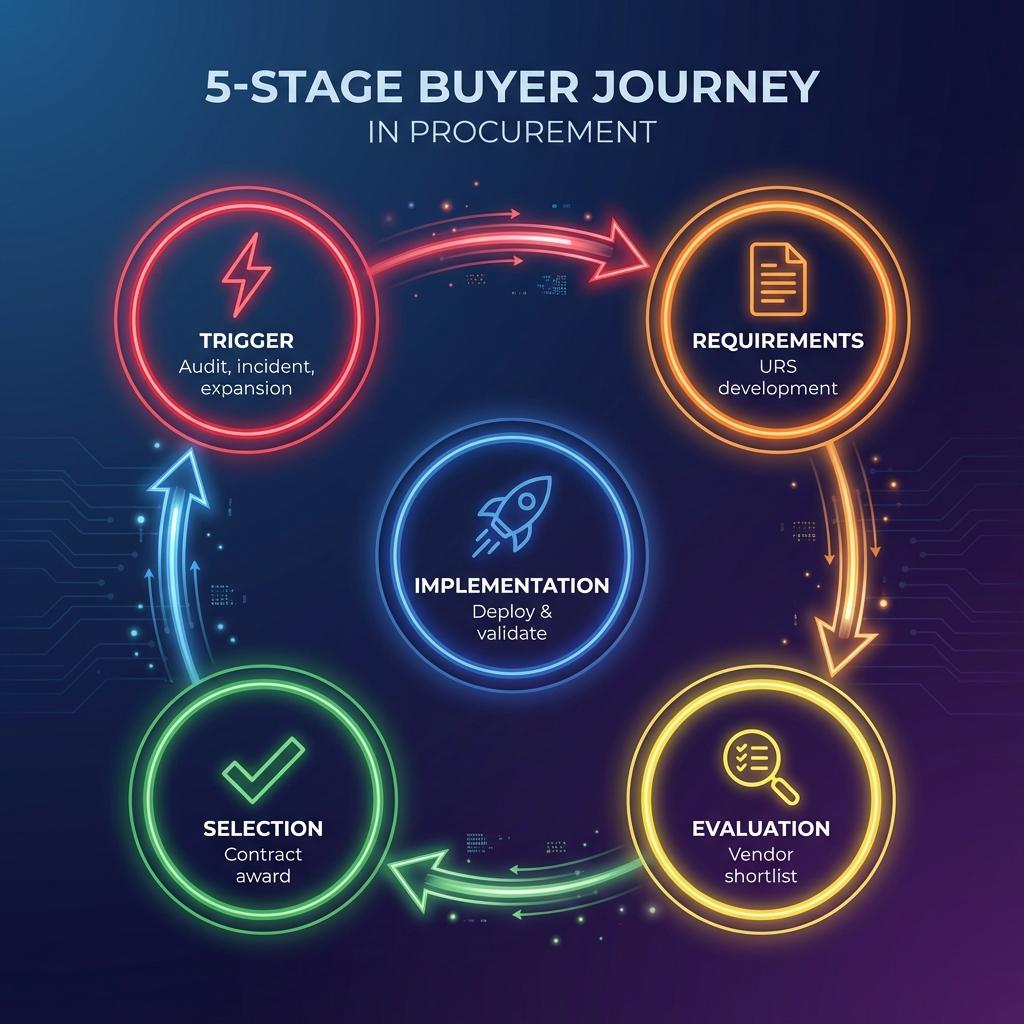
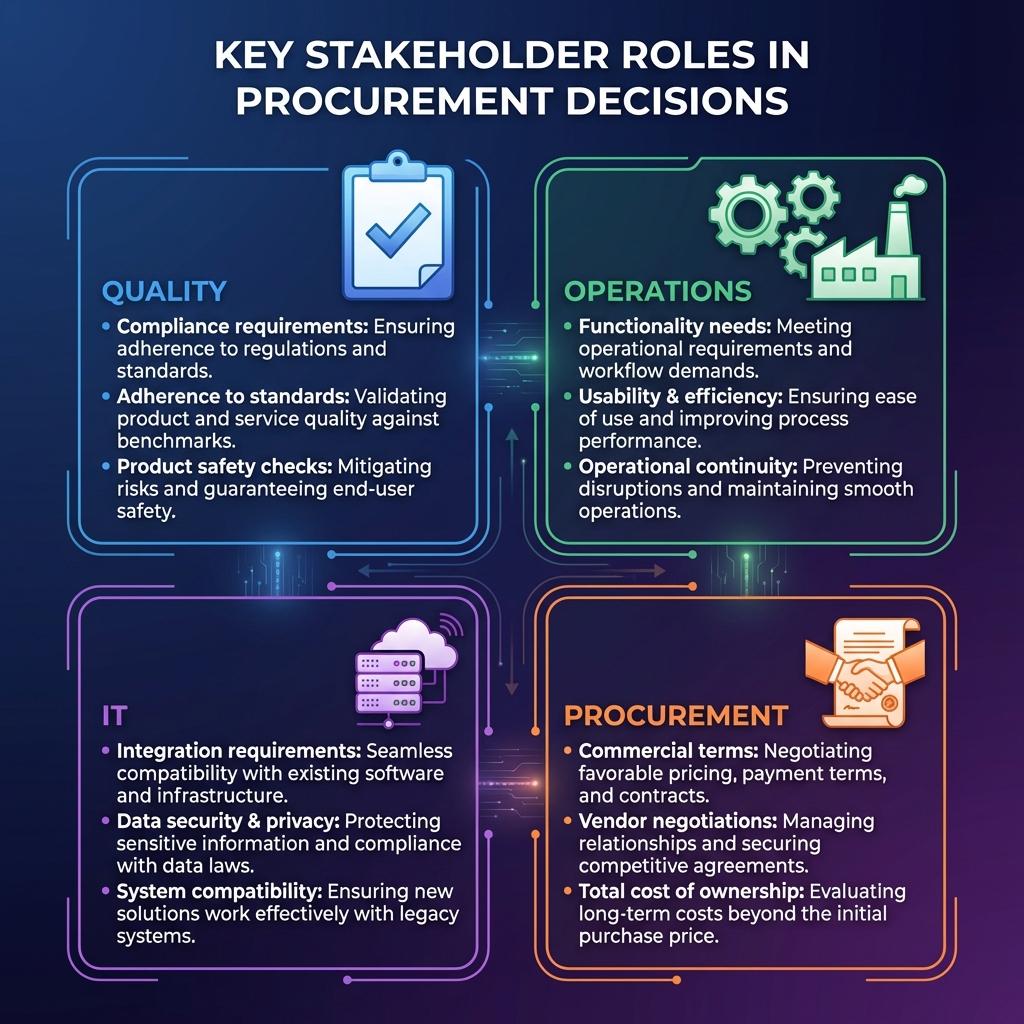
🧭 Chapter 6: How Organisations Actually Buy – Buyer Journey, Stakeholders, Governance
By now, you know what a good temperature mapping & monitoring system looks like and where it is needed.
This chapter answers a different question:
How does a serious organisation actually decide, buy, and roll out such a system without chaos, rework, or audit pain?
We’ll look at:
- A universal 7-stage buyer journey that works across pharma, food, logistics, and data centres.
- A stakeholder map that clarifies who really cares about what.
- Governance practices that keep decisions anchored in Quality & Compliance, rather than in “who pushed the PO through fastest.”
6.1 Universal 7-Stage Buyer Journey
The journey is remarkably similar across industries, even if the labels change. Think of it as 7 stages from “we might have a problem” to “this is our global standard”.
6.1.0 Overview Table – 7 Stages at a Glance
| Stage | Name | Trigger Question | Primary Owners (Ideal) |
|---|---|---|---|
| 1 | Problem Recognition | “Do we actually have a temperature control risk?” | Quality, Operations |
| 2 | Category Consideration | “What type of solution do we even need?” | Quality, Engineering, IT |
| 3 | Solution Discovery | “Who can help us and what’s out there?” | Quality, Procurement, IT |
| 4 | Evaluation & Validation | “Can we prove this will work and pass audits?” | Quality, Validation, IT, Ops |
| 5 | Internal Consensus | “Can we align risk, cost, and complexity?” | Quality, Ops, IT, Procurement, Finance |
| 6 | Implementation | “How do we roll this out without breaking things?” | Project Lead, Ops, IT, Quality |
| 7 | Expansion & Optimisation | “How do we scale and continuously improve?” | Quality, Ops, Strategy, IT |
Now we unpack each stage.
6.1.1 Stage 1 – Problem Recognition
Typical triggers
- Regulatory or customer audit observation about storage, transport, or data integrity.
- A serious excursion: batch at risk, product destruction, stock-out, or IT / data centre outage.
- Internal risk review (e.g., enterprise risk assessment, business continuity planning).
- Strategic change: new site, new product category, new export market, new data hall.
What good looks like
- Quality / Compliance takes ownership and frames this as a risk/control issue, not just a “gadget upgrade”.
- Clear articulation of the problem:
- “We cannot demonstrate temperature control in warehouse X.”
- “We lack validated monitoring for our vaccine cold chain.”
- “We cannot correlate rack-level temperatures with ASHRAE guidelines in the primary data hall.”
Common failure modes
- Problem treated as purely technical (“we just need some new loggers”).
- Procurement is asked to “get quotes for data loggers” before requirements are defined.
- IT or Engineering starts exploring tools in isolation, without Quality / Compliance involvement.
6.1.2 Stage 2 – Category Consideration
Once the problem is acknowledged, the organisation asks:
“What type of solution will close this risk in a sustainable, auditable way?”
Key questions
- Do we need mapping only, or mapping plus continuous monitoring?
- Single site, or a multi-site / multi-country platform?
- Hardware-only (loggers) vs integrated hardware + software + services?
- How strictly do we need to adhere to GxP / HACCP / ASHRAE / data integrity requirements?
Outputs of this stage
- A high-level solution vision, such as:
- “A validated, multi-site monitoring platform with central dashboards, plus mapping and calibration services.”
- “A standardised approach to mapping and monitoring across all refrigerated warehouses and reefers.”
- “DCIM-integrated temperature and environmental monitoring aligned with ASHRAE classes.”
Good practice
- Quality leads the conversation; Engineering, IT, Operations provide feasibility input.
- Early reality-check against regulatory expectations and company risk appetite.
- Decision that this is a system (stack), not just a product purchase.
6.1.3 Stage 3 – Solution Discovery
Now the team moves from “what type of solution” to “who can plausibly deliver it?”
Activities
- Market scan: whitepapers, guidelines, vendor-neutral publications, peer references.
- RFI (Request for Information) to understand classes of solutions, not just prices.
- Internal benchmarking: what is already used in other sites / business units / regions?
Key questions
- Which vendors or partners can support:
- Hardware suitable for our environments.
- GxP-/HACCP-/ASHRAE-aligned methodology for mapping and validation.
- Multi-site deployment and integrations (BMS, WMS, DCIM, QMS).
- Data integrity features (audit trails, access control, electronic signatures).
Good practice
- Quality defines screen-out criteria (non-negotiable compliance, calibration, and data integrity requirements).
- Procurement is involved to understand commercial models, but does not over-optimise on price at this stage.
- IT / OT is involved early to assess integration feasibility and cybersecurity.
6.1.4 Stage 4 – Evaluation & Validation
This is where “nice PowerPoint” becomes “can we prove this works for us?”
Typical steps
- URS (User Requirement Specification) finalisation
- Authored by Quality, with input from Operations, IT, Engineering, Logistics, Data Centre Ops.
- Includes regulatory expectations, mapping/monitoring/calibration requirements, data integrity, and IT/OT constraints.
- Technical & functional evaluation
- Vendor demos, technical deep-dives, security / architecture reviews.
- Reference checks with existing users in similar industries.
- Pilot / proof-of-concept
- Limited deployment in one or two critical environments (e.g., a high-risk warehouse, a main data hall, or a key cold room).
- Formal pilot protocol with success criteria: performance, usability, compliance, alarm behaviour, report quality.
- Validation planning
- Risk-based Computer System Validation (CSV) or equivalent for the platform.
- Qualification plans (IQ/OQ/PQ) for environments and equipment.
Success criteria
- The solution demonstrably meets URS, not just the vendor datasheet.
- Quality and Validation are satisfied that the system can be defended in an audit.
- IT / OT confirms the architecture is supportable, secure, and scalable.
6.1.5 Stage 5 – Internal Consensus
By now, everyone has opinions. This stage is about aligning risk, cost, and complexity.
Who’s at the table
- QA / Validation
- Operations / Warehouse / Production / Logistics
- IT / Data Centre Ops / OT
- Procurement
- Finance / CXOs or Site Leadership
Negotiations typically revolve around
- Scope vs cost – Single site vs multi-site; minimal vs comprehensive rollout.
- Deployment timeline – Immediate risk hot spots vs phased implementation.
- Standardisation – Whether this will be the corporate standard or just a local solution.
Healthy consensus looks like
- Quality has veto power on compliance-critical aspects (data integrity, calibration, mapping method).
- Procurement optimises cost within the set of solutions that Quality has deemed acceptable.
- IT / OT influences architecture and integration decisions, not the compliance baseline.
- Leadership explicitly signs off on:
- Risk that is being mitigated.
- Investment being made.
- Expected outcomes (audit robustness, fewer excursions, fewer manual tasks, better uptime).
6.1.6 Stage 6 – Implementation
This is where many organisations underestimate the work and end up with half-implemented systems.
Key implementation streams
- Technical deployment
- Installation of sensors, loggers, gateways, servers, and network segments.
- Configuration of sites, rooms, devices, thresholds, and user roles in the platform.
- Qualification & validation execution
- IQ/OQ/PQ according to approved protocols.
- Mapping studies, alarm challenge tests, failover tests, backup/restore tests.
- Process & SOP integration
- Updating or creating SOPs for mapping, monitoring, alarm response, calibration, data review.
- Aligning with existing deviation, CAPA, and change control processes.
- Training & change management
- Training operators, supervisors, QA reviewers, IT administrators.
- Communication around “why we’re doing this” to avoid seeing it as surveillance or bureaucracy.
What good looks like
- A named project owner and a cross-functional project team.
- Clear go-live criteria (e.g., validation completed, key users trained, SOPs effective).
- Parallel running with existing systems during cutover, where appropriate, to avoid blind spots.
6.1.7 Stage 7 – Expansion & Optimisation
Once the first implementation is stable, the forward-looking question is:
“How do we turn this into a corporate asset instead of a one-off project?”
Expanding
- Rolling out to additional sites, rooms, vehicles, or data halls using the same architecture and templates.
- Harmonising practices across geographies (e.g., global SOPs with local appendices).
- Consolidating legacy solutions into the new standard over time.
Optimising
- Using trend data to:
- Improve setpoints and deadbands.
- Optimise energy use without risking excursions.
- Identify recurring issues (door practices, specific vehicles, hotspots).
- Periodic reviews of alarm rates, response times, and excursion frequency.
- Benchmarking performance across sites and partners.
End-game
- The system becomes part of how the organisation manages risk and operational performance, not just “how we pass audits.”
- Quality and Operations see the platform as a daily tool, not just a regulatory obligation.
6.2 Stakeholder Map
Buying and running a temperature mapping & monitoring system is never a one-person show. Different groups come with different agendas, fears, and KPIs. Understanding this landscape early helps you shape a coherent decision process instead of a political tug-of-war.
6.2.1 Core Stakeholders & What They Care About
| Function / Role | Typical Titles / Teams | What They Care About Most | What They Fear Most |
|---|---|---|---|
| QA / Validation | Head of QA, QA Manager, Validation Lead, QP, QCU | Compliance, data integrity, defendable evidence, audit readiness | Findings, warning letters, recalls, “unvalidated” systems |
| Operations / Production / Logistics | Warehouse Managers, Production Heads, Logistics Managers | Smooth operations, minimal downtime, simple workflows | Constant false alarms, unworkable SOPs, systems that slow them down |
| IT / Data Centre Ops / OT | CIO, IT Manager, DC Ops Lead, OT/Automation Engineers | Cybersecurity, stability, standardisation, integration | Shadow IT, insecure devices, unmanageable vendor sprawl |
| Procurement | Category Managers, Strategic Sourcing, Vendor Management | Total cost, contract terms, supplier reliability | Overpaying, fragmented spend, bypassed processes |
| Finance & CXOs | CFO, COO, Site Head, BU Head | Risk reduction, predictable costs, strategic alignment | Paying for “gold plating”, surprise liabilities, reputational hits |
6.2.2 Stakeholder Influence by Journey Stage
A simple way to visualise influence is to mark who should be Leading (L), Consulted (C), or Informed (I) at each stage.
| Stage | QA / Validation | Operations / Logistics | IT / DC Ops / OT | Procurement | Finance / CXOs |
|---|---|---|---|---|---|
| 1. Problem Recognition | L | C | C | I | I |
| 2. Category Consideration | L | C | C | I | I |
| 3. Solution Discovery | L | C | C | C | I |
| 4. Evaluation & Validation | L | C | C | C | I |
| 5. Internal Consensus | L | C | C | C | C/L |
| 6. Implementation | L (for compliance) | L (for operations) | L (for infrastructure) | C | I |
| 7. Expansion & Optimisation | L (for governance) | L | C | C | C |
The critical pattern is obvious:
- Quality / Validation leads from Stage 1 onward.
- Procurement is never entirely out of the loop, but it is not the architect of the solution.
- IT / OT is a permanent co-pilot once a digital platform is on the table.
6.2.3 Stakeholder Narratives – How to Position the Initiative
When you communicate internally, each group needs its own storyline, anchored in the same reality.
- To QA / Validation
- “This is how we close our biggest temperature-related compliance gaps and make future audits boring instead of dramatic.”
- To Operations / Logistics / Production
- “This will reduce firefighting around excursions and give you clear, actionable alarms instead of surprises and blame games.”
- To IT / Data Centre Ops / OT
- “We’re choosing a platform that fits your security and integration standards, instead of a patchwork of unmanageable devices.”
- To Procurement
- “We’ll give you a clearly defined field of compliant options; within that, you’re free to negotiate a great commercial outcome and manage supplier performance.”
- To Finance & CXOs
- “This reduces exposure to recalls, regulatory actions, SLA penalties, downtime, and brand damage. It pays for itself in risk avoided, efficiency, and standardisation.”
6.3 Governance Best Practices
This is where we codify who holds the pen and who holds the wallet—without compromising on risk control.
You’ve already hinted at the key principles:
- URS authored by QA.
- Procurement only negotiates pre-approved vendors.
- IT & QA jointly validate platform readiness.
- Calibration & mapping frequency decided by Quality.
Now we turn those into a practical governance model.
6.3.1 URS Authored by QA – With Structured Input
Why it matters
The URS is the contract between your risk profile and your solution stack. If Operations, IT, or Procurement write it alone, you tend to get something that is optimised for usability, tools, or cost—but not necessarily for compliance and defensibility.
Good practice
- QA owns the URS document and final sign-off.
- A structured input process is used:
- Operations contributes environment specifics and workflow needs.
- IT / OT contributes architectural, security, and integration constraints.
- Logistics / Data Centre Ops contribute transport and uptime-specific requirements.
What the URS must cover, at minimum
- Environments and temperature ranges covered.
- Mapping requirements (per environment type).
- Monitoring requirements (sensor density, sampling frequency, alarm logic).
- Calibration and traceability requirements.
- Data integrity expectations (ALCOA+, audit trails, access controls, e-signatures where relevant).
- Validation / qualification and documentation expectations.
- Integration requirements (BMS, WMS, DCIM, QMS, ERP).
Only once this is signed off by QA should you move to vendor-specific RFPs.
6.3.2 Procurement Only Negotiates Pre-Approved Vendors
Principle
Quality decides what is acceptable. Procurement decides on which acceptable vendor gives the best value.
How to implement
- Stage 1: QA & Validation create acceptability criteria from the URS.
- Stage 2: Candidate vendors are filtered:
- Those that fail core compliance or data integrity requirements are rejected early, regardless of price.
- Stage 3: Procurement runs commercial evaluations, RFPs, negotiations only among vendors who passed QA’s filter.
Advantages
- Prevents “cheapest non-compliant vendor” outcomes.
- Aligns Procurement with their real value-add: cost optimisation, contract structuring, supplier management—not technical risk decisions.
6.3.3 IT & QA Jointly Validate Platform Readiness
Treat the monitoring platform like any other mission-critical system.
Joint responsibilities
- QA / Validation
- Define which functions are GxP-/risk-critical.
- Approve validation strategy (risk-based CSV or equivalent).
- Review and sign off on test plans, traceability matrices, and reports.
- IT / OT
- Own infrastructure aspects: network design, backups, cybersecurity hardening, high availability.
- Support performance, load, failover, and restoration tests.
- Ensure ongoing patching/upgrade policy doesn’t silently break validation.
Practical governance
- Maintain a System Owner (often in QA or a cross-functional role) plus a named IT Technical Owner.
- Establish formal change control for:
- Software updates.
- Major configuration changes.
- Integration modifications.
- Periodically review system health: audit trail integrity, backup tests, alarm statistics, user access.
6.3.4 Calibration & Mapping Frequency Decided by Quality
Calibration and mapping should be risk-based, but the risk owner is Quality—not the calibration vendor, and not the maintenance contractor.
Calibration governance
- QA approves the calibration policy, including:
- Initial intervals by instrument type / criticality.
- Rules for shortening intervals (e.g., after out-of-tolerance findings).
- Rules for extending intervals (e.g., after multiple cycles of stable results).
- Metrology / maintenance teams execute the policy and report exceptions.
- Procedures for impact assessment where “as-found” errors exceed defined limits are owned by QA.
Mapping governance
- QA approves a mapping master plan, defining:
- Which environment classes require mapping (e.g., all pharma warehouses, all vaccine cold rooms, all reefer classes, core data halls).
- Baseline frequency (e.g., every 1–3 years, plus after significant changes).
- Event-driven mapping triggers (major modifications, repeated deviations, new product categories, critical process changes).
- Temperature mapping service providers and internal engineering execute according to approved protocols; QA approves protocols and final reports.
This keeps calibration and mapping where they belong: under the stewardship of those who sign batch releases, defend audits, and own patient / consumer / uptime risk.
6.3.5 Simple Governance Blueprint – Putting It All Together
You can summarise the governance model like this:
| Decision / Artefact | Primary Owner | Key Co-Owners / Inputs |
|---|---|---|
| Problem statement & risk assessment | QA | Operations, Logistics, DC Ops |
| URS for mapping & monitoring | QA | Ops, IT/OT, Logistics, DC Ops |
| Vendor acceptability shortlist | QA | IT/OT |
| Commercial negotiation & contracting | Procurement | QA, IT/OT, Finance |
| System validation strategy & execution | QA / Validation | IT/OT, Vendor |
| Calibration policy & intervals | QA | Metrology / Maintenance |
| Mapping master plan & frequency | QA | Ops, Logistics, Engineering |
| Change control & upgrades | QA + IT/OT | System Owner, Vendor |
| Performance & risk reviews | QA | Ops, IT/OT, Finance, Leadership |
If your internal reality matches this table, you’re in a good place.
If it doesn’t, Chapter 6 is your polite justification to change that.
How to Use Chapter 6
- As a design reference when you formalise your internal project charter and governance for any new mapping & monitoring initiative.
- As a conversation framework with leadership to clarify that this is not a “tool purchase” but a cross-functional risk and governance decision.
- As an internal alignment tool for QA, Ops, IT, Procurement, and Finance to agree on roles before vendors ever enter the room.
With the journey, stakeholders, and governance model clear, the next chapters can safely move into URS templates, evaluation scorecards, and future-proofing—because you’ll know exactly who will own them and how they’ll be used.
Buyer Journey Process
This flowchart shows the procurement stages and decision points: