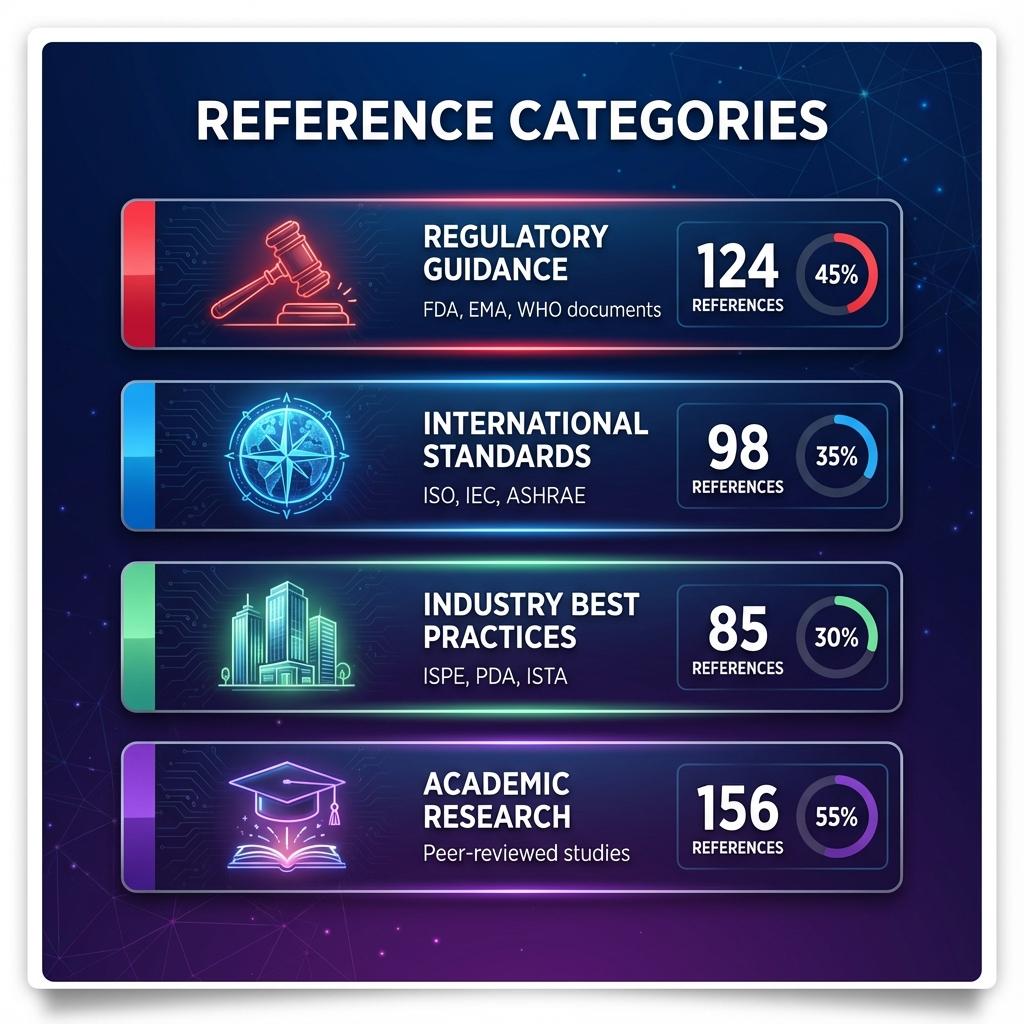
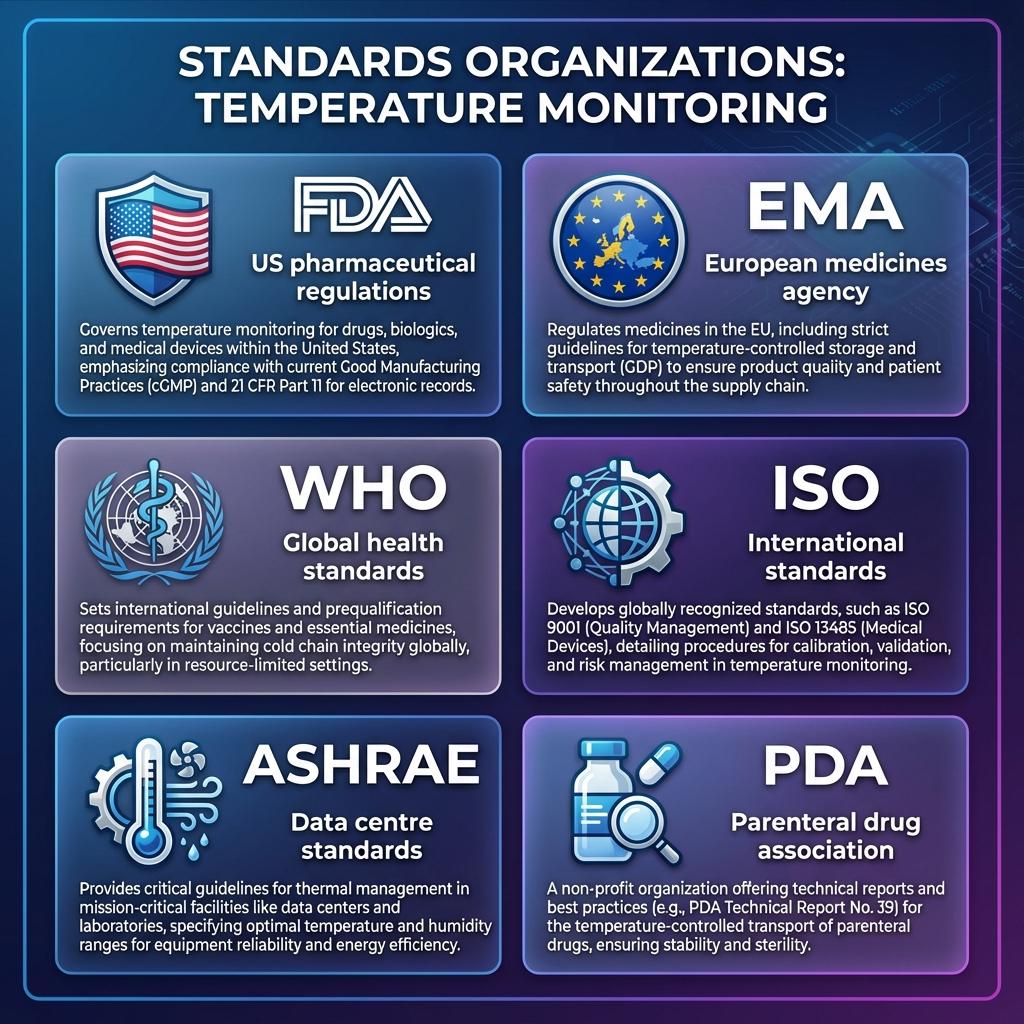
1. Regulatory Guidance (FDA, EMA, WHO, MHRA, etc.)
1.1 United States – FDA & Federal Rules (Pharma, Biologics, Data Integrity, Food & Cold Chain)
| Ref ID | Issuer | Title | Year | Scope / Relevance | Public Link |
|---|---|---|---|---|---|
| US-01 | FDA / eCFR | 21 CFR Part 11 – Electronic Records; Electronic Signatures | Current | Baseline legal requirements for electronic records/signatures used by temperature monitoring systems (audit trails, e-sigs, timestamps). | Link |
| US-02 | FDA | Guidance for Industry – Part 11, Electronic Records; Electronic Signatures – Scope and Application | 2003 | Explains FDA’s enforcement discretion for Part 11 and what they actually expect from computerised systems in practice. | |
| US-03 | FDA | Data Integrity and Compliance With CGMP – Questions and Answers (Guidance for Industry) | 2018 | Core data integrity expectations for GxP systems: ALCOA+, audit trails, user access, record lifecycle; directly relevant to compliant monitoring platforms. | |
| US-04 | FDA | FSMA Final Rule on Sanitary Transportation of Human and Animal Food | 2016 | Establishes responsibilities for shippers, loaders, carriers, receivers, including temperature control, monitoring, and documentation for transported food. | Rule summary |
| US-05 | FDA | FSMA Food Traceability Final Rule – Requirements for Additional Traceability Records for Certain Foods (FSMA 204) | 2022 | Extends traceability and record-keeping for high-risk foods; reinforces expectations on documented time–temperature control along the cold chain. | Rule summary |
| US-06 | FDA | FSMA – Food Traceability List | 2022 | Lists foods subject to enhanced traceability requirements (many temperature-sensitive categories: soft cheeses, seafood, cut produce, etc.). | List |
How to use in the Guide: These documents anchor all claims around electronic data integrity, cold-chain documentation, and legal responsibility in US pharma and food supply chains.
1.2 European Union & EEA – GDP / GMP / Computerised Systems
| Ref ID | Issuer | Title | Year | Scope / Relevance | Public Link |
|---|---|---|---|---|---|
| EU-01 | European Commission | EU Guidelines on Good Distribution Practice of Medicinal Products for Human Use (2013/C 343/01) | 2013 | Primary EU GDP text – explicitly requires temperature control, monitoring, qualification and mapping of storage/transport for medicinal products. | |
| EU-02 | EC / EMA | EudraLex Volume 4 – EU Guidelines for GMP – Annex 11: Computerised Systems | 2011 | Defines expectations for validated computerised systems used in GxP (including monitoring platforms): risk-based validation, audit trails, security, backup. | |
| EU-03 | WHO / EMA-aligned | Guide to Good Distribution Practices for Pharmaceutical Products (often implemented via national transposition) | 2010+ | Used by many regulators as base text for GDP; cross-aligns with WHO GDP and EU GDP on storage/transport temperature control. | Reference in WHO how-to guide |
1.3 United Kingdom – MHRA & GxP
| Ref ID | Issuer | Title | Year | Scope / Relevance | Public Link |
|---|---|---|---|---|---|
| UK-01 | MHRA | GxP Data Integrity Guidance and Definitions | 2018 | Central UK reference for data integrity across GxP. Reinforces ALCOA+, audit trails, security, and record lifecycle expectations for monitoring systems. |
1.4 WHO & Multilateral Guidance – Storage, Distribution, Mapping, Monitoring, Data
| Ref ID | Issuer | Title | Year | Scope / Relevance | Public Link |
|---|---|---|---|---|---|
| WHO-01 | WHO | Model guidance for the storage and transport of time- and temperature-sensitive pharmaceutical products (TTSPP) – TRS 961, Annex 9 | 2011 | Core WHO guidance for TTSPP storage & transport; explicitly references mapping, qualification, and monitoring expectations in global pharma cold chains. | Referenced in: How to temperature map… |
| WHO-02 | WHO | Good distribution practices (GDP) for pharmaceutical products – TRS 957, Annex 5 | 2010 | Framework for GDP in many non-EU markets; includes requirements for maintaining temperature during storage and distribution. | Referenced in same WHO how-to guide above |
| WHO-03 | WHO | Good storage and distribution practices for medical products – TRS 1025, Annex 7 | 2020 | Updated global GDP for all medical products – consolidates and modernises expectations on mapping, monitoring, qualification, and documentation. | Unofficial PDF mirror |
| WHO-04 | WHO | Guidance on good data and record management practices – TRS 996, Annex 5 | 2016 | Foundational global guidance on data integrity and record management – strongly aligned with ALCOA+ and used by many regulators. | |
| WHO-05 | WHO | Technical Supplement: Temperature mapping of storage areas (Supplement 8 to TRS 961 Annex 9) | 2014/2015 | The definitive WHO guide for designing and executing temperature mapping studies (protocol, logger layout, durations, seasons, reporting). | |
| WHO-06 | WHO | Technical Supplement: Temperature and humidity monitoring systems for fixed storage areas (Supplement 6 to TRS 961) | 2015 | Detailed guidance on selection and placement of monitoring sensors in warehouses, cold rooms, freezers, etc. | |
| WHO-07 | WHO / UNICEF / PATH | How to temperature map cold chain equipment and storage areas (2nd ed.) | 2022 | Practical, step-by-step field guide for mapping cold rooms, freezers, vaccine equipment; includes forms, examples, and links back to TRS 961/992/1025. |
2. International & Industry Standards
These are standards you reference, not quote. Many are paid; links go to official catalogue pages or authoritative summaries.
2.1 Calibration, Labs, and Measurement
| Ref ID | Body | Standard | Year | Relevance | Public Info |
|---|---|---|---|---|---|
| ST-01 | ISO / IEC | ISO/IEC 17025:2017 – General requirements for the competence of testing and calibration laboratories | 2017 | The main accreditation standard for calibration labs. Supports your argument that data loggers and probes should be calibrated at ISO/IEC 17025-accredited labs for traceability. | ANSI Webstore summary |
2.2 Food Safety & HACCP
| Ref ID | Body | Standard | Year | Relevance | Public Info |
|---|---|---|---|---|---|
| ST-02 | Codex Alimentarius | General Principles of Food Hygiene (CXC 1-1969) – including HACCP Annex | 1969, rev. 2020 | Global reference for HACCP and food hygiene. Requires time–temperature control and monitoring throughout food production, storage, and distribution. | PDF (Rev. 4-2003, with HACCP annex) / Overview of 2020 revision |
2.3 Data Centres, IT & OT
| Ref ID | Body | Standard / Guidance | Year | Relevance | Public Info |
|---|---|---|---|---|---|
| ST-03 | ASHRAE | Thermal Guidelines for Data Processing Environments (4th Edition) | 2015 | Defines recommended and allowable temperature & humidity envelopes for IT equipment classes (A1–A4 etc.); cornerstone for data-centre temperature requirements. | CIBSE catalogue entry (purchase required) |
| ST-04 | IATA | Perishable Cargo Regulations (PCR) | Ongoing (e.g., 22nd–25th ed.) | Industry standard for air transport of temperature-sensitive perishables (food, flowers, some pharma); defines packaging, handling & temperature control requirements. | IATA PCR info (manual itself is paid) |
| ST-05 | IEC / ISA | IEC 62443 – Industrial communication networks – IT security for networks and systems (series) | 2009–ongoing | OT cybersecurity standard series for industrial automation & control systems. Relevant where temperature monitoring integrates with SCADA/BMS and must be segmented/secured. | Overview |
2.4 GxP Computerised Systems & Good Practice Guides
| Ref ID | Body | Document | Year | Relevance | Info |
|---|---|---|---|---|---|
| ST-06 | ISPE | GAMP 5 – A Risk-Based Approach to Compliant GxP Computerized Systems | 2008, 2nd ed. 2022 | Widely used framework for validating GxP software, including monitoring platforms; reinforces lifecycle, risk-based testing, and supplier assessments. | Overview / purchase |
| ST-07 | ISPE | Good Practice Guide: Controlled Temperature Chambers (2nd Edition) | 2021 | Industry guide for qualification and mapping of controlled chambers (stability, incubators, cold rooms). Frequently cited alongside WHO supplements. | Listed in Ellab’s mapping guidance; available via ISPE (paid). |
3. Industry Whitepapers & Neutral Technical Guidance (Non-Vendor Product-Marketing)
These are non-regulatory, practice-oriented documents that give colour, examples, and practical checklists for your Buyer’s Guide. They are useful for “what this looks like on the ground”.
| Ref ID | Publisher / Author | Title | Year | Notes / Use in Guide | Link |
|---|---|---|---|---|---|
| IW-01 | WHO / UNICEF / PATH | How to temperature map cold chain equipment and storage areas (2nd ed.) | 2022 | Extremely practical manual for field mapping; includes logger layouts, forms, data analysis examples; can be used as a visual reference for mapping process diagrams. | |
| IW-02 | WHO | Technical Supplement – Temperature mapping of storage areas (TS to TRS 961) | 2014/15 | Deep dive on mapping methodology (protocol, seasons, empty vs loaded, reporting). Perfect backbone for “what good mapping looks like” in pharma & vaccines. | |
| IW-03 | WHO | Technical Supplement – Temperature and humidity monitoring systems for fixed storage areas (TS to TRS 992 Annex 5) | 2015 | Operational guidance for continuous monitoring: number and location of probes, relationship to mapping results, alarm handling. | |
| IW-04 | WHO / blog republish | WHO guidelines temperature mapping of storage areas – summary | 2019 | Blog-style summary of WHO mapping supplement; useful for simplified explanations and for cross-checking that your Buyer’s Guide remains aligned with WHO language. | Article |
| IW-05 | CoolPac (technical article referencing WHO) | WHO Annex 9: Temperature Mapping of Storage Areas | ~2017 | Industry article explaining Annex 9 implications for warehouses and cold rooms; provides practitioner-level language around hot/cold spots and risk of excursions. | Article |
| IW-06 | ITU-T | Recommendation ITU-T L.1304 – Assessment of energy efficiency for data centre infrastructure | 2020 | Contains bibliography referencing ASHRAE Thermal Guidelines and EU green public procurement; useful when tying data-centre mapping/monitoring to sustainability and energy optimisation. |
4. Case Studies, Incident Analyses & Audit-Style Materials
These are not exhaustive, but they give you credible, real-world stories to sprinkle through the Guide when you want to show “what happens when this goes wrong.”
Note: Many formal audit reports and warning letters are case-specific and dispersed. Below are representative, citable sources that illustrate patterns of failure around cold chain and data centre thermal incidents.
| Ref ID | Domain | Source / Title | Year | Key Insight | Link |
|---|---|---|---|---|---|
| CS-01 | Pharma / Cold Chain | Technical Supplement: Temperature mapping of storage areas – examples & annexes (WHO TS to TRS 961) | 2014/15 | Contains example mapping forms, data tables and commentary on what constitutes hot/cold spots and how poorly placed sensors or inadequate mapping can miss risk zones. | |
| CS-02 | Pharma / Warehousing | Temperature and humidity monitoring systems for fixed storage areas – practical examples (WHO Supplement 6) | 2015 | Includes scenario-based guidance where wrong probe placement or insufficient monitoring generates excessive alarms or hides real excursions; useful for “lesson learned” call-outs. | |
| CS-03 | Pharma / Biopharma | How to temperature map cold chain equipment and storage areas – worked examples | 2022 | Provides practical cases showing mapping before and after loading, seasonal variation, and remediation actions – you can adapt these into anonymised case vignettes. | |
| CS-04 | Food / HACCP | Codex General Principles of Food Hygiene (CXC 1-1969) – HACCP Annex | 2003/2020 | While not a narrative case study, Annex examples show how failures in time–temperature control become CCP deviations leading to unsafe food – ideal for structured “what can go wrong” examples in food & retail. | |
| CS-05 | Data Centres | California Title 24 Stakeholder presentation referencing ASHRAE Thermal Guidelines | 2018 | Contains data-centre case illustrations and ASHRAE-based environmental classes, showing that operating too close to envelope limits or with poor airflow containment raises outage risk. |
For more “story-like” case examples (recalls due to excursions, data-centre outages during heatwaves), you can layer in recent news reports and warning letters when drafting the actual narrative sections, but this core set keeps your bibliography anchored on stable, citable documents.
5. How to Use This Bibliography in the Buyer’s Guide
When you start final drafting:
-
Chapter 1–3 (why it matters, core concepts, regulation)
Anchor claims with US-01–05, EU-01–02, UK-01, WHO-01–04, ST-02.
-
Chapters 4–5 (environments, solution stack, mapping vs monitoring)
Lean heavily on WHO-05–07, IW-01–03, ST-03–05 for technical nuance on mapping, monitoring, and data-centre specifics.
-
Chapters 6–8 (buyer journey, URS, evaluation)
Use US-02–03, EU-02, UK-01, ST-06–07 when justifying validation, data integrity, and governance requirements.
-
Chapters 9–10 & Appendix (implementation roadmap, future-proofing)
Cite US-03–05, WHO-03–04, ST-03–05, ST-06, ST-07, IW-06 when you talk about digitalisation, multi-site monitoring, cybersecurity, and increasing regulatory scrutiny.
📑 Chapter-Wise Key References (Drop-In Blocks)
Note: These reference codes (US-01, WHO-03, ST-03, etc.) map 1:1 to the full entries in your Bibliography & Source Index. No need to repeat URLs in the chapters; the bibliography carries them.
🔹 Chapter 1 – Why Temperature Mapping & Monitoring Is Now a Strategic Priority
Key References for Chapter 1
- WHO-03 – Good storage and distribution practices for medical products (WHO TRS 1025, Annex 7) – global baseline for why storage/transport control is a governance and risk issue, not just operations.
- WHO-01 – Model guidance for the storage and transport of time- and temperature-sensitive pharmaceutical products (TRS 961, Annex 9) – underpins risk framing for TTSPPs.
- US-03 – FDA: Data Integrity and Compliance With CGMP – Q&A – supports the “data = liability” argument and the ALCOA+ positioning.
- US-04 / US-05 – FSMA Sanitary Transportation and Food Traceability Final Rule – show how food supply chains are being regulated around temperature and traceability.
- ST-02 – Codex General Principles of Food Hygiene (incl. HACCP annex) – foundation for “temperature control as a critical control point” in food.
- ST-03 – ASHRAE Thermal Guidelines for Data Processing Environments – basis for “temperature as a strategic uptime risk” in data centres.
🔹 Chapter 2 – Understanding the Building Blocks
Key References for Chapter 2
- WHO-05 – Technical Supplement: Temperature mapping of storage areas (TRS 961) – canonical definitions and lifecycle view of mapping.
- WHO-06 – Technical Supplement: Temperature and humidity monitoring systems for fixed storage areas – underpins your mapping vs monitoring vs probe placement narrative.
- WHO-07 / IW-01 – How to temperature map cold chain equipment and storage areas (2nd ed.) – excellent practical anchor for examples and terminology.
- WHO-04 – Guidance on good data and record management practices (TRS 996) – supports ALCOA+ and lifecycle of electronic records.
- ST-01 – ISO/IEC 17025 – baseline for calibration traceability and calibration certificate interpretation.
🔹 Chapter 3 – Regulatory & Compliance Drivers
Key References for Chapter 3
- US-01 – 21 CFR Part 11 – Electronic Records; Electronic Signatures – legal basis for audit trails, e-signatures and system controls.
- US-02 – Part 11 Scope and Application Guidance – nuances around what’s actually in scope for monitoring platforms.
- US-03 – FDA Data Integrity Q&A – key for interpreting data integrity expectations.
- EU-01 – EU Guidelines on Good Distribution Practice of Medicinal Products (2013/C 343/01) – main EU GDP reference for storage/transport mapping and monitoring.
- EU-02 – EU GMP Annex 11 – Computerised Systems – foundation for “validated monitoring platform” arguments.
- UK-01 – MHRA GxP Data Integrity Guidance and Definitions – supports any UK / global data integrity framing.
- WHO-01 / WHO-03 – Model guidance for TTSPP and Good storage and distribution practices for medical products – your global GDP/GSP backbone.
- ST-02 – Codex HACCP – when you describe food, cold chain and retail regulatory drivers.
- ST-03 – ASHRAE Thermal Guidelines – specific authority for data centre thermal envelopes.
- ST-04 – IATA Perishable Cargo Regulations – supports your cold-chain logistics regulatory expectations (especially air freight).
🔹 Chapter 4 – Where These Solutions Are Needed
Key References for Chapter 4
- WHO-05 / WHO-06 / WHO-07 – the trio of WHO mapping & monitoring supplements plus the 2nd-ed “How to map” guide – practical foundation for warehouses, cold rooms, freezers, vaccine stores.
- WHO-01 / WHO-03 – to justify mapping & monitoring expectations across pharma warehouses, hospitals, and clinics.
- ST-02 – Codex General Principles of Food Hygiene – to ground the discussion of food plants, blast freezers, retail cabinets, and HACCP CCPs.
- US-04 / US-05 – FSMA sanitary transport & traceability – when talking about 3PLs, reefer trucks, and integrated cold chains.
- ST-03 – ASHRAE Thermal Guidelines – for data halls, white space, hot/cold aisles and edge rooms.
🔹 Chapter 5 – The Solution Stack – What Goes Into a System
Key References for Chapter 5
- WHO-06 – Temperature and humidity monitoring systems for fixed storage areas – strongly supports hardware, probe types, density, and sampling interval guidance.
- WHO-05 / WHO-07 – for how mapping outputs drive hardware selection and probe placement.
- WHO-04 – Good data & record management practices – reinforces your requirements for audit trails, system controls, and data lifecycle in the software layer.
- ST-01 – ISO/IEC 17025 – calibration & traceability expectations for data loggers and reference probes.
- ST-06 – GAMP 5 – framework for risk-based validation and lifecycle of the monitoring platform.
- ST-07 – ISPE GPG: Controlled Temperature Chambers – detailed guidance that supports your controlled chambers, stability rooms, incubators sections.
- ST-03 / ST-05 – ASHRAE Thermal Guidelines and IEC 62443 – for data-centre temp ranges and OT security context, respectively.
🔹 Chapter 6 – Buyer Journey, Stakeholders & Decision Ownership
Key References for Chapter 6
- US-03 – FDA Data Integrity Q&A – supports your stance that Quality/Data Integrity are risk owners and must lead requirements.
- UK-01 – MHRA Data Integrity Guidance – emphasises governance, roles and responsibilities for data-critical systems.
- EU-02 – Annex 11 – Computerised Systems – basis for IT/QA joint ownership & validation responsibilities.
- WHO-03 / WHO-04 – storage & distribution + data/record management guidance – anchor your argument that regulators expect quality-led governance, not procurement-only decisions.
- ST-06 – GAMP 5 – used to justify lifecycle, stakeholder involvement, and a risk-based approach to system acquisition and validation.
🔹 Chapter 7 – How to Specify Requirements (URS & RFP Guidance)
Key References for Chapter 7
- EU-02 – Annex 11 – directly supports URS content around access control, audit trails, backup, security, and validation duties.
- US-01 / US-02 / US-03 – Part 11 + Scope & Application + Data Integrity Q&A – justify every URS line related to electronic records, signatures, audit trails, and data controls.
- UK-01 – MHRA Data Integrity Guidance – backs your URS sections on ALCOA+, privilege separation, and periodic review.
- WHO-04 – Good data & record management practices – global underpinning for data integrity requirements in the URS.
- ST-01 – ISO/IEC 17025 – supports URS sections on calibration and certificate expectations.
- ST-06 – GAMP 5 – basis for URS clauses on validation documentation, supplier support, and change management.
🔹 Chapter 8 – Evaluating Vendors – What Good Looks Like
Key References for Chapter 8
- EU-02 – Annex 11 – key for evaluating software capabilities, validation maturity, and lifecycle controls.
- US-03 / UK-01 / WHO-04 – triad of data integrity documents that justify your evaluation pillars for audit trails, user management, and record lifecycle.
- WHO-05 / WHO-06 / WHO-07 – justify scrutiny of vendor mapping methodology, logger deployment strategies, and reporting quality.
- ST-01 – ISO/IEC 17025 – basis for checking calibration support and lab competence.
- ST-06 / ST-07 – GAMP 5 and Controlled Temperature Chambers GPG – used to judge vendors on validation support, documentation, and domain expertise.
🔹 Chapter 9 – Implementation Roadmap
Key References for Chapter 9
- WHO-05 / WHO-06 / WHO-07 – these are practically “implementation manuals” for mapping and monitoring; they support your protocol design, logger placement, and reporting steps.
- WHO-03 – storage & distribution practices – backs your expectations around requalification, deviations, and CAPA.
- WHO-04 – data/record management – foundational for your backup, restore and audit-trail parts of the roadmap.
- ST-06 – GAMP 5 – grounds your IQ/OQ/PQ and change-control narrative in industry consensus.
- ST-01 – ISO/IEC 17025 – for calibration programmes and impact assessment for out-of-tolerance findings.
🔹 Chapter 10 – Future-Proofing to 2026 and Beyond
Key References for Chapter 10
- US-03 – Data Integrity Q&A – supports your direction of travel on stronger digital audit expectations.
- US-05 / US-06 – FSMA Food Traceability Final Rule + Traceability List – basis for the increasingly tight requirements on traceability and cold-chain records.
- WHO-03 / WHO-04 – show the global move towards digital, risk-based, lifecycle thinking in GDP and data integrity.
- ST-03 – ASHRAE Thermal Guidelines – underpins the “thermal envelope compliance & energy optimisation” storyline for data centres.
- ST-05 – IEC 62443 series – core reference for your OT/IT convergence and cybersecurity expectations.
- ST-06 – GAMP 5 (2nd ed.) – for risk-based computer software assurance and future-proof validation practices.
- IW-06 – ITU-T L.1304 – handy when discussing integration of monitoring data into broader data-centre efficiency and sustainability metrics.
🔹 Appendix – Templates, Checklists, Scorecards & Glossary
Key References for Appendix
- WHO-05 / WHO-06 / WHO-07 – templates and checklists in A–G are effectively “friendly, vendor-agnostic translations” of these WHO documents.
- WHO-04 – anchors the Audit-Readiness Checklist and URS sections related to data integrity.
- US-01 / US-02 / US-03 / UK-01 – cited implicitly in any template requiring audit trails, e-signatures, and user access control.
- ST-01 – calibration frequency table (Appendix F) is built conceptually on ISO/IEC 17025-style traceability and risk-based intervals.
- ST-06 – URS & validation language in the Appendix assumes a GAMP 5 style lifecycle.