📖 Chapter 1: Why Temperature Mapping & Monitoring Is Now a Strategic Priority
1.0 Framing the Shift: From “Nice-to-Have” to Boardroom Issue
Ten years ago, temperature mapping and monitoring were often treated as technical hygiene: a project you delegated once, ticked off for audits, and revisited only when there was a failure or an inspection.
Today, that luxury is gone.
- Regulators expect continuous evidence, not periodic snapshots.
- Customers and license partners expect your cold chain, warehouses, data rooms, and fleets to behave like a controlled process, not a best-effort operation.
- Boards and CXOs have realised that a single temperature excursion can cascade into product loss, contract penalties, stock-outs, patient or consumer harm, and very public damage to trust.
Across pharma, frozen and chilled foods, cold chain logistics, and now data centres and digital infrastructure, temperature control has quietly become a strategic risk domain—on par with cybersecurity, supply continuity, and financial controls.
This chapter explains why that is happening, and who should actually own the decisions about temperature mapping and monitoring in a modern organisation.
1.1 Temperature Control as a Business Risk
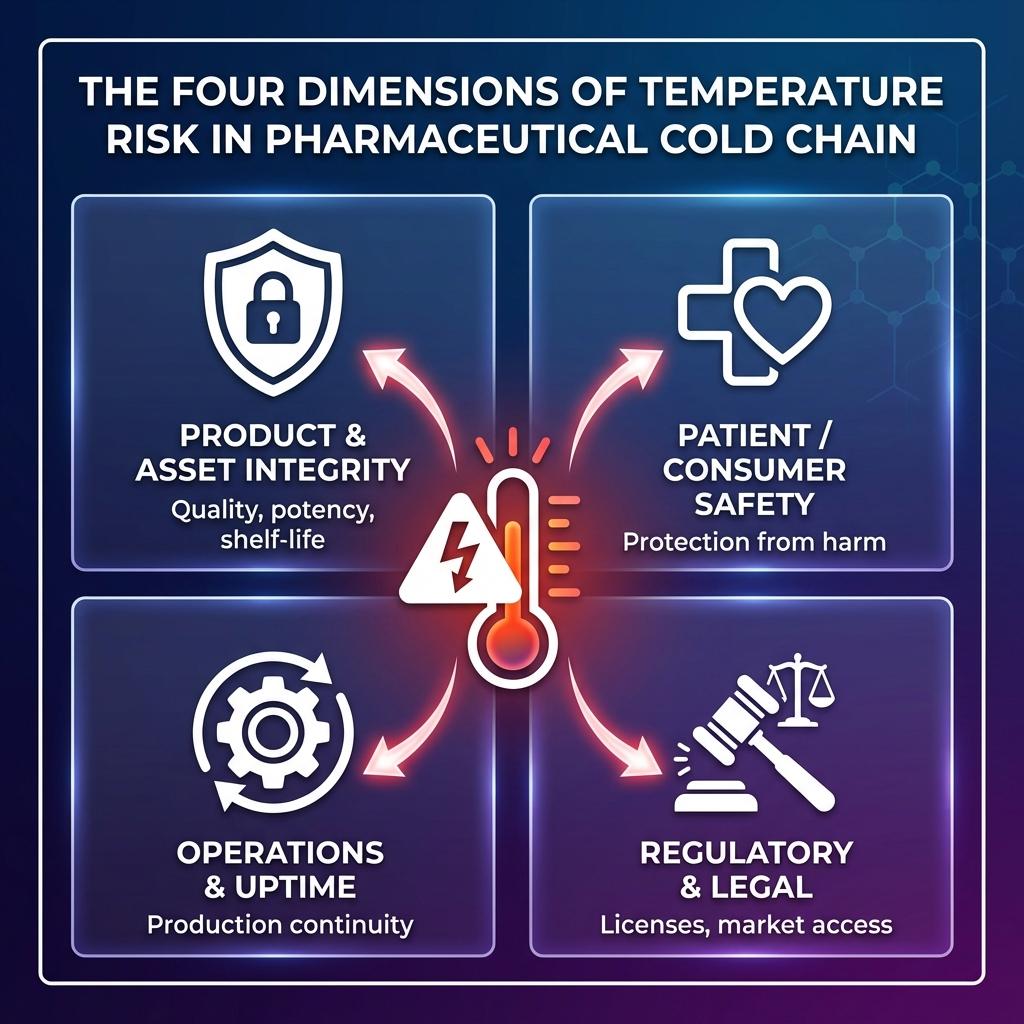
Temperature control is not only a technical parameter. It is a cross-cutting business risk with concrete impacts across four dimensions:
1.1.1 The Four Dimensions of Temperature Risk
| Dimension | What’s at Risk | Typical Consequences |
|---|---|---|
| 1. Product & Asset Integrity | Quality, potency, safety, shelf-life, equipment lifespan | Product rejection, rework, recalls, scrap, shortened asset life |
| 2. Patient / Consumer Safety | Patients, end-users, food consumers | Adverse events, illness, harm, loss of life in extreme cases |
| 3. Operations & Uptime | Production continuity, IT and data services | Downtime, lost batches, service outages, SLA penalties |
| 4. Regulatory & Legal | Licences, approvals, market access, legal exposure | Warning letters, import alerts, fines, license suspensions, contract termination |
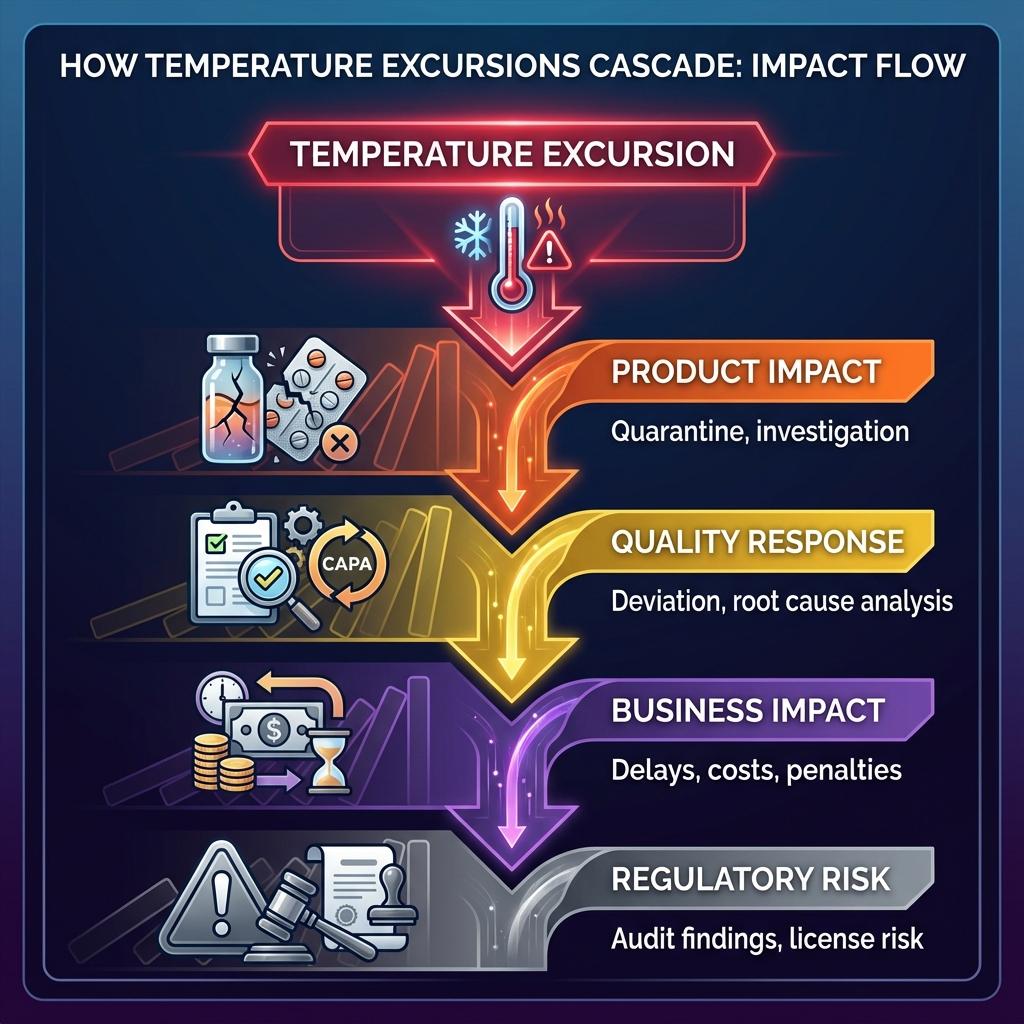
Temperature excursions sit at the intersection of all four. One “small” deviation can show up simultaneously as:
- A batch that fails release or must be quarantined.
- A deviation that needs investigation and CAPA.
- A near-miss (or actual harm) to patients/consumers.
- An observation in an audit report that triggers deeper scrutiny.
In data centres and server environments, the same logic applies with different artefacts:
- The “product” is compute availability and data integrity.
- The “excursion” is sustained operation outside recommended ranges.
- The outcome is service degradation, equipment damage, or downtime with legal and commercial consequences.
Seen this way, temperature is not just “engineering data”; it is risk evidence.
1.1.2 How Excursions Actually Happen in the Real World
Most serious temperature-related events are not caused by exotic failures. They come from very ordinary patterns that repeat across industries:
- Design issues
- Inadequate understanding of hot/cold spots before use.
- Poor airflow in cold rooms, freezers, or server racks.
- Inadequate insulation or inappropriate equipment selection for the load profile.
- Operational and human factors
- Doors left open too long in cold rooms or reefers.
- Overloading or inconsistent loading patterns that change airflow.
- Poorly controlled defrost cycles in freezers and blast units.
- Unauthorised adjustments to setpoints or control parameters.
- Equipment and infrastructure failures
- Refrigeration system failures, blocked condensers/evaporators.
- Power interruptions without adequate backup or transfer systems.
- Failed or degraded fans in server racks, blocked vents in hot/cold aisles.
- Instrumentation and calibration gaps
- Sensors drifting out of calibration with no robust schedule to detect it.
- Loggers used beyond their validated operating range.
- Outdated probes or loggers reused without re-calibration or verification.
- Data integrity and visibility gaps
- Standalone data loggers that are only checked “when someone remembers.”
- Manual logs maintained for show—backfilled, incomplete, or illegible.
- Monitoring software without robust alarms, audit trails, or user controls.
Temperature mapping and monitoring do not prevent any of these factors by themselves. What they do is:
- Reveal the true behaviour of the environment (mapping).
- Detect deviations fast enough to act (monitoring).
- Provide traceable evidence that controls are working (data & documentation).
- Support continuous improvement—changing layouts, loading patterns, or equipment before small issues become disasters.
1.1.3 Why “Good Enough” Is No Longer Enough
Historically, many organisations relied on a “good enough” mix of:
- A mapping study at initial qualification.
- A handful of local thermometers or chart recorders.
- A file share or binder full of printed graphs.
This approach is increasingly risky because:
-
Audit expectations have matured
Inspectors are no longer satisfied with “we did a mapping three years ago” and a static report. They expect:
- A clear rationale for sensor placement based on mapping.
- Evidence that mapping is repeated at appropriate intervals or after changes.
- Continuous monitoring with alarm logic tied to documented actions.
- Robust data integrity controls: who changed what, when, and why.
-
Supply chains are more complex and time-critical
In pharma, frozen foods, and cold chain logistics, supply lines are longer and more global. A temperature excursion in one node can now:
- Trigger a network-level recall.
- Disrupt regional or global supply for critical products.
- Create disputes between manufacturers, logistics providers, and distributors over liability.
-
Digital infrastructure is non-negotiable
For data centres and server rooms, slightly elevated temperatures or poor thermal distribution can:
- Shorten equipment life.
- Increase error rates and unplanned reboots.
- Breach SLAs with banks, telecoms, logistics providers, or hospital information systems.
-
Boards and insurers are paying attention
Insurers, auditors, and boards are increasingly asking for hard evidence of controls. A “good enough” system with weak mapping, gaps in monitoring, and poor calibration is hard to defend after a major event.
This is why temperature mapping and monitoring are now strategic: they protect revenue, reputation, and licence to operate—not just compliance checkboxes.
1.2 Not Just Pharma: A Cross-Industry Imperative
Temperature control requirements emerged strongly from pharma and healthcare, but the same principles now apply to any operation where:
- Product quality and safety are temperature-dependent, or
- Uptime and equipment health are temperature-dependent.
Below, we outline what is at stake in the key domains.
1.2.1 Pharmaceuticals & Biotech
Where temperature is critical
- API and formulation manufacturing areas.
- Finished-product warehouses and distribution centres.
- Cold rooms, freezers, and ultra-low freezers for biologics and vaccines.
- Stability chambers, incubators, and controlled room-temperature stores.
- Hospital pharmacies and clinical trial depots.
What’s at stake
- Potency, stability, and safety of medicines, vaccines, and biologics.
- Compliance with GMP/GDP, with direct implications for licences and market access.
- Ability to defend product quality during investigations or field complaints.
Typical temperature control pain points
- Mapping performed only once (at commissioning) rather than over the lifecycle.
- Weak linkage between mapping results and permanent sensor placement.
- Mix of old chart recorders, USB loggers, and newer digital systems with no harmonised view.
- Calibration programmes that exist on paper but are hard to demonstrate in practice.
For pharma, temperature mapping and monitoring are not optional; they are fundamental to demonstrating control to regulators and global customers.
1.2.2 Frozen & Chilled Food
Where temperature is critical
- Processing plants handling meat, seafood, dairy, ready meals, and bakery products.
- Bulk cold stores, blast freezers, and high-throughput pre-coolers.
- Retail refrigerated cabinets and freezers in supermarkets and QSR chains.
What’s at stake
- Microbiological safety and shelf-life of food products.
- Compliance with HACCP plans and national food safety regulations.
- Brand reputation with retailers and end consumers.
Typical temperature control pain points
- Over-reliance on spot checks or manual logbooks in cold rooms and vehicles.
- Wide variation in practices between plants, warehouses, and retail points.
- Limited mapping or validation of display cabinets and retail cold equipment.
- Limited visibility across the end-to-end cold chain—especially during transport and last mile.
The industry is moving from “we keep it cold” to demonstrable, documented cold chain control, especially for export markets and large retail contracts.
1.2.3 Cold Chain Logistics (Pharma + Food)
Where temperature is critical
- 3PL-managed warehouses and distribution hubs.
- Reefer trucks, containers, and temperature-controlled air/sea freight.
- Cross-dock facilities and consolidation centres.
What’s at stake
- Integrity of goods while in transit, often across multiple carriers and borders.
- Contractual obligations to maintain specific temperature profiles.
- Liability in case of excursions—who pays for lost product, rework, or recall.
Typical temperature control pain points
- Inconsistent practices between carriers and lanes.
- Limited or fragmented tracking of in-transit data.
- Disputes over whether excursions actually occurred and how severe they were.
- Weak integration of logistics temperature data into manufacturers’ quality systems.
Here, mapping and monitoring are about lane validation, route risk assessment, and being able to provide a defensible story for each shipment—not just a logger printout at the end.
1.2.4 Data Centres & Uptime-Critical Facilities
Where temperature is critical
- Enterprise data centres and co-location facilities.
- On-prem server rooms in factories, banks, hospitals, and logistics control towers.
- Edge data centres in remote or space-constrained sites.
What’s at stake
- Availability of core business systems (ERP, MES, WMS, trading platforms, hospital HIS, etc.).
- Protection of hardware assets worth millions of dollars.
- Compliance with uptime standards, SLAs, and internal risk policies.
Typical temperature control pain points
- Hot/cold aisle containment not fully validated under real loads.
- Sensors limited to CRAC unit returns or room averages rather than per-rack distributions.
- Weak correlation between CFD models and actual measured conditions.
- Limited integration between environmental sensing, BMS/DCIM, and incident management.
For data centres, thermal mapping and monitoring are core to capacity planning, risk management, and power optimisation. A surprising number of incidents still trace back to “we thought the room was fine, but that rack was running 10 °C hotter than we realised.”
1.2.5 Other Regulated & High-Risk Environments
The same logic extends to:
- Blood banks and transfusion services.
- Central and peripheral vaccine stores.
- Clinical labs and research environments handling sensitive samples.
- Chemical and specialty materials storage where runaway reactions are temperature-triggered.
Across all these contexts, the pattern is identical:
If temperature goes wrong, something important breaks—product quality, safety, uptime, or regulatory compliance.
1.3 Who Owns the Decision: Quality, Not Procurement
If temperature mapping and monitoring are strategic risk controls, the natural question is:
Who should actually own the decision to select technologies, design solutions, and appoint service providers?
The short answer—across regulators, case law, and hard-won industry experience—is:
Quality / Compliance / Risk Owners define what is acceptable; Procurement negotiates among acceptable options.
Treating temperature systems as a pure “IT” or “procurement” commodity is one of the fastest routes to future audit problems.
1.3.1 Governance Rationale: Why QA & Compliance Must Lead
Quality and Compliance functions are the ones who:
-
Own the risk
They sign off on batch release, product disposition, deviation closure, and CAPA. They face inspectors directly and defend the system as “state of control.”
-
Understand the regulatory requirements
They interpret GDP/GMP, HACCP, data integrity, and industry guidance into internal SOPs.
-
Carry the accountability after incidents
When there is a recall, an audit observation, or a major deviation, Quality is the function answering: “How did you qualify your storage? How was temperature monitored? Where is the evidence?”
Because of this, allowing procurement or IT to make unilateral decisions on temperature systems—based mainly on price or generic technical specs—creates a structural misalignment: the people who carry the risk are not the ones who control the technology choice.
Good governance avoids that by making sure:
- Quality/Compliance define the User Requirement Specification (URS) and acceptability criteria.
- Technical functions (Engineering, IT, OT, Data Centre Operations) define the implementation and integration requirements.
- Procurement operates within that envelope to secure the best commercial terms from vendors who meet the URS.
- Senior leadership sponsors the approach and resolves conflicts (e.g., when the cheapest solution is not acceptable from a risk standpoint).
1.3.2 What Goes Wrong When Procurement Leads
When procurement or IT lead without robust QA/Compliance ownership, the symptoms are remarkably consistent across industries:
- Non-compliant or weakly compliant systems
- Monitoring software with no audit trail, no electronic signatures, or no proper time synchronisation.
- Data loggers without appropriate calibration traceability or documentation.
- Systems that cannot demonstrate data integrity under scrutiny.
- Fragmented, unscalable architectures
- Different warehouses, plants, or data rooms using entirely different solutions with no central visibility.
- Mixtures of spreadsheets, stand-alone loggers, and basic SCADA trends—none of which individually meet modern expectations.
- Audit and customer findings
- “Inability to demonstrate mapping rationale for sensor placement.”
- “Lack of evidence that loggers were calibrated over the lifecycle.”
- “Inadequate controls over user access and data changes in monitoring systems.”
- Escalating hidden costs
- Repeated mapping or re-validation because initial solutions were under-specified.
- Extra manual work just to compile usable audit evidence.
- Emergency investments after near-miss events or adverse inspections.
Behind many of these issues is the same origin story:
A well-meaning procurement or IT team chose a cheaper or familiar solution without fully involving Quality/Compliance, and only later discovered that it did not stand up to regulatory or customer expectations.
1.3.3 A Practical Governance Model: “Quality Decides, Procurement Enables”
A simple way to frame decision ownership—across pharma, food, logistics, and data centres—is to make roles explicit.
| Function / Role | Primary Responsibilities in Temperature Mapping & Monitoring Decisions |
|---|---|
| Quality / QA / QC / RA | Define URS, compliance and data integrity requirements; approve acceptable vendors and solutions. |
| Operations / Warehouse / Production / DC Ops | Define operational needs, constraints, and response workflows for alarms and excursions. |
| Engineering / Facilities / OT | Define equipment specs, installation standards, reliability and maintenance requirements. |
| IT / InfoSec / DCIM | Define integration, cybersecurity, infrastructure, and architecture constraints. |
| Procurement / Purchasing | Run sourcing events, negotiate pricing and terms among QA-approved options; manage contracts. |
| Finance / Leadership | Approve budgets, endorse risk appetite, resolve trade-offs between cost and risk. |
In a mature organisation, the process typically looks like this:
- Trigger & Problem Definition
- A significant excursion, audit comment, new facility, or customer requirement triggers a review.
- Quality and Operations jointly define the risk and what must change.
- URS & Governance Setup
- Quality leads creation of a URS covering mapping, monitoring, validation, calibration, and data integrity.
- Technical teams (Engineering/IT) contribute implementability and scalability requirements.
- Market Scan & Vendor Shortlist
- Quality/Compliance validate which vendors and architectures can meet the URS.
- Procurement is involved early, but does not remove vendors purely on price if they are uniquely compliant.
- Evaluation & Pilots
- Cross-functional evaluation, with Quality holding veto rights on non-compliant features.
- Pilots designed to test both technical performance and usability in real workflows.
- Commercial Negotiation & Contracting
- Procurement leads commercial negotiation within the space defined by Quality.
- Contracts include obligations on calibration support, documentation, data access, and audit support.
- Post-Implementation Governance
- Quality owns ongoing performance review, audit readiness, and periodic re-mapping/re-validation triggers.
- Procurement and Finance monitor cost versus value but do not compromise compliance baselines.
This model keeps everyone in their lane:
- Quality owns “What is acceptable?”
- Technical functions own “How do we implement it correctly?”
- Procurement owns “How do we buy it wisely?”
- Leadership owns “Do we accept this level of risk?”
Once this is understood, the rest of the Buyer’s Guide becomes easier to navigate:
- Mapping, monitoring, calibration, and data integrity are no longer “technical features”; they are control levers for risks that Quality is accountable for.
- Procurement still has a critical role—but as an enabler, not the primary decision-maker.
How to Use This Chapter
As you proceed through the rest of the Buyer’s Guide, keep Chapter 1 as your lens:
- When you evaluate environments (warehouses, reefers, data centres), ask: What is the real business impact of failure here?
- When you examine architectures and technologies, ask: Does this give Quality the control and evidence they need?
- When you define your URS and vendor evaluation criteria, ensure the decision authority sits with the functions that will ultimately have to defend those decisions—to regulators, customers, and the board.
That mindset shift—from “buying loggers and software” to designing risk controls and evidence—is what makes temperature mapping and monitoring a strategic priority rather than a grudging cost.
Risk Escalation Process Flow
When a temperature excursion is detected, this flowchart shows the decision process from detection through to resolution: